
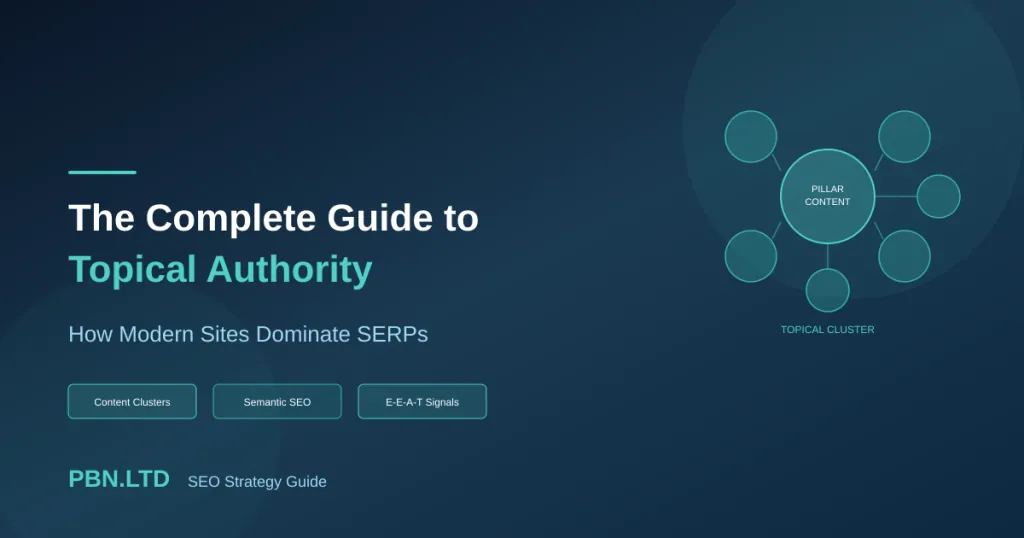
With over a decade of experience building and analysing websites across competitive niches, we’ve observed first-hand how topical authority has become the defining factor in sustainable search visibility.
There was a time when SEO was simpler. Target a keyword, build some links, rank. Those days are gone. Google’s algorithm has evolved to understand topics, entities, and the relationships between them in ways that make old-school keyword targeting increasingly ineffective.
Today, the sites that dominate search results aren’t just optimised for keywords—they’ve established themselves as the definitive authorities on entire subject areas. They don’t just rank for one term; they own the topic.
This is topical authority, and understanding how to build it is perhaps the most important SEO skill in 2026. This guide explains what topical authority actually is, why it matters more than ever, and exactly how to build it for your sites.
What Is Topical Authority?
Topical authority refers to a website’s perceived expertise and comprehensiveness on a particular subject area. When Google recognises a site as a topical authority, it’s more likely to rank that site for queries related to that topic—even for keywords the site hasn’t explicitly targeted.
Think of it this way: if you wanted to learn about coffee, would you trust a general lifestyle blog that has one article about brewing methods, or a dedicated coffee site with hundreds of articles covering everything from bean origins to grinder calibration to water chemistry?
Google thinks the same way. The dedicated coffee site has demonstrated topical authority through comprehensive coverage. It’s proven its expertise by addressing the topic from every angle.
Topical Authority vs. Domain Authority
These concepts are related but distinct:
| Aspect | Domain Authority | Topical Authority |
| Primary driver | Backlink profile strength | Content depth and coverage |
| Scope | Site-wide metric | Topic-specific |
| Measurement | Third-party metrics (DA, DR) | No standard metric; inferred |
| How to build | Acquire more/better backlinks | Create comprehensive topic coverage |
| Transfer | Helps all pages somewhat | Helps topic-related pages significantly |
The ideal scenario is having both: strong domain authority and deep topical authority in your target areas. But if you had to choose, topical authority increasingly wins for sustainable rankings.
Why Topical Authority Matters More Than Ever
Google’s Shift to Semantic Understanding
Google no longer matches keywords—it understands meaning. Through advances like BERT, MUM, and their latest language models, Google grasps the relationships between concepts, the context of queries, and the completeness of content.
This semantic understanding allows Google to recognise when a site truly covers a topic comprehensively versus when it’s just targeting isolated keywords. A site with genuine topical authority demonstrates interconnected knowledge that Google can verify through internal linking patterns, consistent terminology, and coverage of related subtopics.
E-E-A-T and Quality Rater Guidelines
Google’s Quality Rater Guidelines explicitly value expertise and comprehensiveness. When human raters evaluate sites, they look for evidence that the creator truly understands their subject matter. Topical authority is essentially expertise made visible through content.
Sites with strong topical authority naturally score higher on E-E-A-T metrics because their comprehensive coverage demonstrates genuine expertise that’s impossible to fake with a handful of AI-generated articles.
Competitive Moat Building
Here’s the strategic value: topical authority is genuinely hard to replicate quickly. A competitor can buy links. They can hire writers. But building true topical authority requires time, consistency, and depth that can’t be shortcut.
Once you’ve established topical authority, new competitors face a massive barrier. They’re not just competing for individual keywords—they’re competing against your entire body of work and the trust Google has assigned to it.
How Google Evaluates Topical Authority
While Google doesn’t publish its exact methods, analysis of ranking patterns reveals several likely factors:
Content Coverage and Depth
Google appears to map topics into subtopics and entities, then evaluate how thoroughly a site covers these elements. A site about ‘home brewing’ might be expected to cover equipment, ingredients, techniques, recipes, troubleshooting, and related subjects like fermentation science.
Sites that cover more of the expected subtopic map demonstrate greater authority. But it’s not just about having pages—those pages need sufficient depth to satisfy user intent for each subtopic.
Internal Linking Structure
How your content connects matters enormously. Topical authority sites have dense internal linking within topic clusters, showing Google that content is genuinely related and that the site understands these relationships.
Random internal linking or siloed content that doesn’t interconnect fails to demonstrate the topical relationships that signal authority.
External Validation
Backlinks from other topically relevant sites serve as external validation of authority. When respected sites in your niche link to you as a resource, it confirms your authority to Google.
This is where link building strategy intersects with topical authority. Links from relevant sources carry more weight than random high-DA links because they represent genuine endorsement from within your topic area.
Building relevant backlinks requires proper infrastructure. Learn how our hosting supports diverse, niche-relevant link networks.
Engagement and Satisfaction Signals
When users consistently find what they need on your site—spending time, exploring related content, not bouncing back to search results—it signals that your content genuinely serves the topic. These engagement patterns likely influence how Google perceives your topical authority over time.
Building Topical Authority: A Practical Framework
Step 1: Define Your Topic Territory
Start by clearly defining the topic area you want to own. This should be:
- Specific enough to dominate: ‘Digital marketing’ is too broad. ‘Email marketing for e-commerce’ is achievable
- Broad enough to matter: The topic needs sufficient search volume and business value
- Aligned with your expertise: You need genuine knowledge or access to experts
- Realistic given resources: Can you actually create comprehensive coverage?
Step 2: Map the Topic Comprehensively
Before creating content, map everything your topic encompasses:
- Core concepts: The fundamental ideas anyone learning this topic needs
- Subtopics: Major branches that deserve their own content clusters
- Related entities: People, tools, brands, and concepts associated with the topic
- Common questions: What do beginners ask? What do experts debate?
- Adjacent topics: Related areas that provide context
- User journeys: How do people progress from novice to expert?
Tools like keyword research, competitor analysis, ‘People Also Ask’ boxes, and topical modelling can help. But also apply your own expertise—what would a complete guide to this topic include?
Step 3: Create the Content Architecture
Organise your topic map into a content architecture:
- Pillar content: Comprehensive guides covering major subtopics (2,000-5,000+ words)
- Cluster content: Supporting articles addressing specific questions and angles (1,000-2,000 words)
- Hub pages: Navigation pages connecting related content
- Glossary/reference: Definitions and quick references for the topic
Plan internal linking from the start. Every cluster article should link to its pillar. Pillars should link between themselves where relevant. The structure should help both users and Google understand relationships.
Step 4: Prioritise and Execute
You can’t publish everything at once. Prioritise based on:
- Foundation first: Core concepts and pillar content that other pieces will reference
- Quick wins: Lower competition subtopics where you can establish presence quickly
- Business value: Topics closest to conversion or revenue
- Gaps: Subtopics competitors have neglected
Consistency matters more than speed. Publishing thoughtful content steadily over months builds more authority than dumping everything at once (which can actually trigger quality concerns).
Step 5: Build Supporting Signals
Content alone isn’t enough. Support your topical authority with:
- Relevant backlinks: Prioritise links from sites in or adjacent to your topic area
- Author expertise: Establish authors as experts through bios, credentials, and cross-platform presence
- Brand mentions: Get your brand associated with the topic across the web
- Social proof: Reviews, testimonials, and community engagement
Supporting your authority sites with quality PBN infrastructure helps build the link signals that reinforce topical authority. See our hosting solutions.
Common Topical Authority Mistakes
Going Too Broad Too Fast
Many sites fail by trying to cover too much too quickly. A new site publishing content across five different topic areas builds authority in none of them. Focus on one topic until you’ve achieved meaningful coverage, then consider expanding.
Thin Coverage Across Many Keywords
Having 500 articles with 500 words each is worse than having 50 comprehensive pieces. Depth matters more than breadth. Each piece should thoroughly address its subtopic, not just touch on keywords.
Neglecting Internal Linking
Content that doesn’t interconnect fails to signal topical relationships to Google. Internal linking should be deliberate and extensive, showing how your content pieces relate to each other and to the broader topic.
Ignoring Content Updates
Topics evolve. Topical authorities stay current. If your content becomes outdated, your authority erodes. Build content maintenance into your strategy from the start.
Mismatched Link Building
Building links from irrelevant sources doesn’t support topical authority. A cooking site getting links from tech blogs creates mixed signals. Focus link acquisition on topically relevant sources, even if their metrics are lower.
Topical Authority for Different Site Types
Money Sites
For commercial sites, topical authority should align with your business offering. Cover your product/service area comprehensively, including educational content that builds trust before selling. The goal is for Google to recognise you as the expert in whatever you’re selling.
Affiliate Sites
Affiliate sites especially benefit from topical authority because it builds the trust needed to overcome Google’s natural skepticism of affiliate content. Don’t just create product reviews—create comprehensive guides that demonstrate genuine expertise in the product category.
Supporting Sites (PBNs)
Even supporting sites benefit from topical focus. A PBN site with clear topical authority in a niche passes more relevant link value than a general-purpose site. Build your network sites as genuine niche resources, not random article repositories.
Quality PBN sites require quality hosting. Our infrastructure ensures your supporting sites perform like genuine authority sites.
Frequently Asked Questions
How long does it take to build topical authority?
There’s no fixed timeline, but expect 6-18 months of consistent effort for meaningful results in moderately competitive topics. Very competitive areas may take longer; underserved niches can be faster. The key is sustained, quality content production and proper structure—not shortcuts.
Can I build topical authority in multiple topics simultaneously?
Only if you have sufficient resources. Each topic requires dedicated content, internal linking, and supporting signals. Dividing limited resources across multiple topics often results in weak authority across all of them. Most sites should establish authority in one area before expanding.
Is topical authority more important than backlinks?
They work together. Topical authority without backlinks struggles to compete in difficult SERPs. Backlinks without topical authority provide diminishing returns over time. The ideal strategy builds both—comprehensive content supported by relevant, quality links.
How do I measure topical authority?
There’s no direct metric. Proxy indicators include: ranking positions across your target topic keywords, featured snippet acquisition, ‘People Also Ask’ appearances, organic traffic trends, and how quickly new content in your topic area ranks. Improving trends across these indicators suggests growing authority.
Does topical authority transfer if I change domains?
With proper 301 redirects and search console verification, some authority transfers. However, expect temporary ranking fluctuations. The content, structure, and signals need to rebuild on the new domain. Major domain changes should only be done with clear strategic reasons.
Can AI content build topical authority?
AI can assist with content production, but genuine topical authority requires expertise that current AI lacks. AI-generated content that lacks original insight, experience, or genuine expertise won’t build lasting authority. Use AI as a tool to assist expert creators, not as a replacement for expertise.
Building for Sustainable Rankings
Topical authority isn’t a quick win—it’s a long-term strategy. But that’s exactly what makes it valuable. While competitors chase algorithm changes and quick fixes, sites with genuine topical authority maintain stable, growing organic traffic.
The investment required is substantial: comprehensive content, thoughtful structure, relevant link building, ongoing maintenance. But the payoff is a competitive moat that’s genuinely difficult to replicate.
Start by choosing your topic territory wisely. Map it completely. Build systematically. Support with quality links. Maintain over time. This is how modern sites dominate SERPs—not through tricks, but through demonstrated expertise that both users and Google recognise as authoritative.
Building Authority Across Your Network
Topical authority applies to every site in your ecosystem—including supporting sites and PBNs. At PBN.LTD, we provide the hosting infrastructure that allows you to build topically focused networks without technical footprints. Each site can develop as a genuine niche authority, passing maximum relevant value to your money sites. Explore our hosting platform to see how we support authority building at scale.