
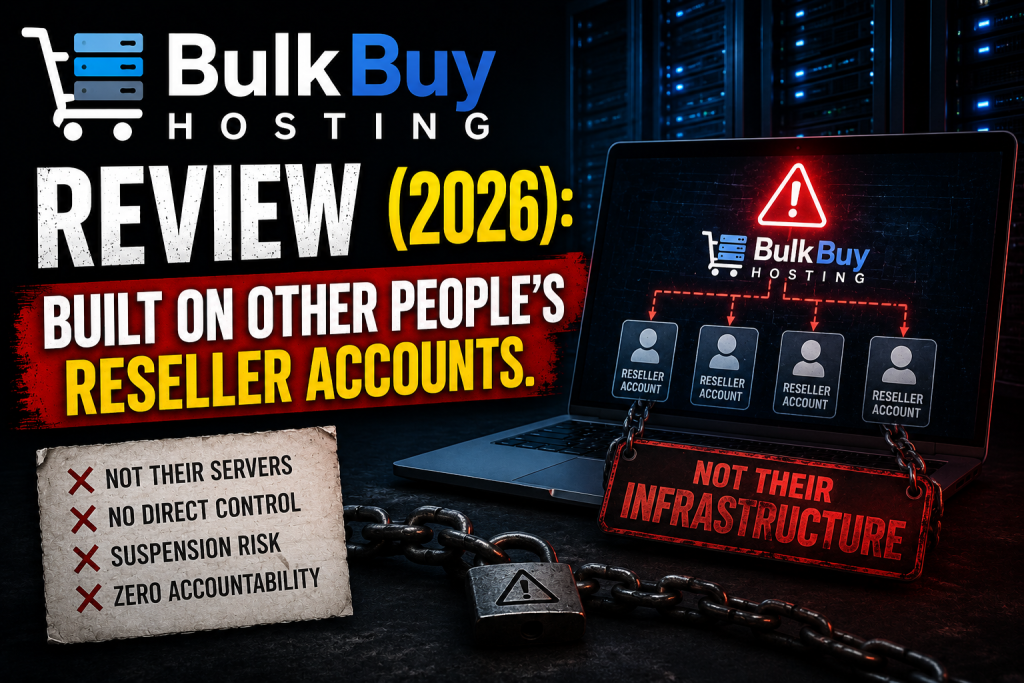
Let’s start with the part of this niche almost nobody understands. Out of every PBN hosting brand on the market, PBN.LTD is the only one that even comes close to being an actual hosting company. The rest are reseller panels built on top of other companies’ reseller panels — basic API integrations bolted onto someone else’s cPanel or DirectAdmin instance, with a payment processor stuck on the front and a brand name stuck on the dashboard. It is the technical equivalent of setting up a control panel that talks to 20i’s API and calling yourself a “PBN hosting company.” You are not a hosting company. You are a UI on top of a hosting company. And Bulk Buy Hosting is the most polished, most heavily-marketed example of that pattern in the niche.
Bulk Buy Hosting is, in the most literal possible sense, a reseller pretending to be a hosting company. They write this on their own product page, in their own words: their entire infrastructure is “cPanel and DirectAdmin reseller hosting accounts from 15 different shared hosting companies.” They do not own servers. They do not own IPs. They do not run a data center. They do not control an ASN. They do not operate a network. They do not have root access on a single machine your PBN sites will ever live on. They are the middleman between you and someone else’s shared hosting account, with a dashboard layered on top, a 10% recurring affiliate program funding their listicle placements, and a parent company in Singapore that operates three other hosting brands at the same time.
That single fact — no server-side control — is the entire ball game. Everything else in this review flows from it. Bulk Buy Hosting cannot change the Apache Server: header your sites send. They cannot change the X-Powered-By PHP version exposure. They cannot change the SSL chain ordering, the cipher suite preference, the HTTP/2 frame ordering, or the TCP fingerprint of the box. They cannot change the default Apache 404 page, the ETag generation pattern, the mod_security WAF responses, or the cgi-sys/defaultwebpage.cgi stub that ships with every cPanel installation. They cannot change the server’s NTP-synced clock skew, the timezone setting, the compression algorithm preference, or the default Softaculous WordPress install pattern. They cannot do any of this because they don’t have root, they don’t have sudo, and they don’t even have WHM-level access to the boxes they’re reselling. They have a cPanel reseller dashboard at someone else’s hosting company. That’s it.
Google sees every one of those server-level signals on every site they crawl. So does Ahrefs, Majestic, Semrush, the Moz API, Common Crawl, and the dozens of cheaper backlink databases that have been clustering shared-hosting fingerprints for the better part of a decade. When Bulk Buy Hosting puts ten of your PBN sites onto ten cPanel accounts inside one HawkHost reseller package, those ten sites broadcast an identical server fingerprint at the OS, web server, and TLS layers — and that fingerprint is also identical to every other shared-hosting customer at HawkHost, including all the other Bulk Buy Hosting customers also stuffed into reseller packages on the same machines. The “diverse IPs” pitch is a layer-3 distraction from a layer-7 disaster. This review is about that disaster, in detail, with primary sources for every claim.
It will be long. There are twelve numbered problems. Every one of them is sourced to Bulk Buy Hosting’s own documentation, their parent company’s legal terms, their support knowledgebase, third-party customer reviews, or the Wayback Machine. We are not making claims we cannot prove. We are also not pulling punches, because the SEO industry has been running on affiliate-laundered “best PBN hosting” content for so long that anyone running a real network deserves the unvarnished version.
Problem #1: They cannot change a single server-side setting — and that is the entire ball game.
This is the master problem. Every other problem in this review is downstream of it. Bulk Buy Hosting does not own a single server your PBN sites will ever live on. They rent cPanel and DirectAdmin reseller accounts from third-party hosting companies. A reseller account, in cPanel terms, is a customer-tier account with the ability to create sub-accounts inside a quota the upstream provider has carved out for them. It is not root access. It is not WHM-level administrative control. It is not sysadmin access to the operating system. It is a customer dashboard with a few extra buttons.
This matters because every server-level footprint your PBN sites broadcast — the signals that Google, Ahrefs, Majestic, Semrush and every footprint analyzer above $50/month uses to cluster networks — is set at a layer Bulk Buy Hosting cannot touch. The reseller account ships with whatever the upstream provider configured at the OS and web server layers, and there is no mechanism inside cPanel for a reseller customer to override it. Here is a non-exhaustive list of the server-level fingerprints Bulk Buy Hosting cannot change, ever, on any site they host for you:
- The Apache (or LiteSpeed)
Server:response header — controlled byServerTokensin the main Apache config, which lives in/etc/httpd/conf/httpd.confand is owned by the upstream provider’s sysadmins. Reseller customers cannot edit this file. Every site at HawkHost broadcasts the same Server header. Every site at NameHero broadcasts a different one but it is identical across all NameHero customers. Cluster signal. - The
X-Powered-ByPHP version exposure — controlled byexpose_phpin/etc/php.ini. Reseller customers can sometimes setexpose_php=Offin a per-account.user.ini, but the default behaviour at every upstream provider is whatever the provider chose, and that default is what every site under that provider broadcasts. - The SSL/TLS chain ordering and cipher suite preference — set at the web server’s
SSLCipherSuiteandSSLHonorCipherOrderdirectives in the main config. Reseller customers cannot override the cipher list. Every BBH site at, say, ChemiCloud will negotiate TLS in the same order, with the same cipher preference, returning the same intermediate certificate chain. Joining ten of those into a “diverse” PBN is a TLS-fingerprint cluster the size of a small country. - The HTTP/2 frame ordering and connection preface behaviour — fully controlled at the web server build level. Identical across all customers of a provider.
- The TCP fingerprint at the kernel level — TCP window size, MSS, timestamp behaviour, ECN support — all set in the host OS’s sysctl. Reseller customers do not see
/etc/sysctl.conf, let alone edit it. Every site at every cheap shared host has the host’s TCP fingerprint, and those fingerprints are well-documented in the public passive-OS-detection databases. - The default Apache 404, 403 and 500 error pages — the
ErrorDocumentdirectives in the main config. cPanel ships with a recognisable default page that includes the cPanel build version and a “Powered by cPanel” footer in the HTML comments. Every cPanel-hosted site that hasn’t customised its 404 page broadcasts this string; Bulk Buy Hosting cannot remove the default at the server level. - The
ETagheader generation pattern — set by theFileETagdirective. Different upstream providers use different defaults (INode MTime Size,MTime Size, etc.). The pattern is identical across every customer at one provider. - The mod_security WAF rule set and 403 response signature — the WAF response body is identical across every site behind that WAF, and there are public databases mapping WAF signatures to upstream hosts.
- The NTP-synced server clock skew — measurable from the
Date:response header, and consistent within milliseconds across every site on the same physical box. Footprint analysts have been using this for years to cluster hosts. - The compression algorithm advertising in
Accept-Encodingnegotiation — Brotli vs gzip preference, compression level, dictionary use. Set at the web server build level. - The default Softaculous one-click WordPress install pattern — the default DB table prefix, the default admin username, the default plugin set, the default file ownership, the default
wp-config.phpstructure. Every BBH customer who clicks the one-click WP install gets the same fingerprint as every other BBH customer at the same upstream provider, and the same fingerprint as every real shared-hosting customer at the same upstream provider — but the BBH customer also clusters with every other BBH-hosted site at that provider, because the install pattern is identical. - The cPanel build version and patch level — exposed in cPanel-related response headers, in the
/cpsessURL paths, in the AutoSSL behaviour. Every cPanel reseller account at one provider runs the same cPanel build because the upstream provider patches the whole fleet at once. - The CloudLinux LVE signature and resource-throttling behaviour — visible in process limits, in 503 response patterns, in CPU stall timing. Bulk Buy Hosting’s own knowledgebase admits in the article “How to tell if your web site is using more resources than it should” that “each account has limits on the amount of CPU, RAM, Disk I/O and Entry Processes” — those limits, and the way the system enforces them, are themselves a cluster signal.
- The
cgi-sys/defaultwebpage.cgistub that cPanel installs by default at the document root of new accounts and on virtual hosts that haven’t been pointed at content yet. The literal HTML string"This page is used to test the proper operation of the Apache HTTP server"is one of the most-fingerprinted strings on the public web.
None of those settings are user-configurable from a cPanel reseller account. All of them are visible to Google’s WebSite Render Pipeline on every crawl. All of them are visible to every commercial backlink crawler. Bulk Buy Hosting cannot fix any of this, because they don’t own the servers. They cannot fix it on a cheap plan, they cannot fix it on the most expensive plan, and they cannot fix it for an “enterprise” customer either, because nobody at Bulk Buy Hosting has root on those boxes. The only people who could fix it are the upstream sysadmins at HawkHost, ChemiCloud, NameHero and the rest — and those sysadmins have no contractual relationship with you, no obligation to even know you exist, and no incentive to randomise their server fingerprints to help an unrelated third-party brand’s PBN customers blend in.
This is why we keep saying Bulk Buy Hosting is not a hosting company. They are an API panel built on top of someone else’s reseller panel. The actual hosting company in your supply chain is HawkHost (or ChemiCloud, or NameHero, or whichever of their 23 partners your specific site landed on), and that hosting company has zero idea you exist, zero obligation to support your use case, and an Acceptable Use Policy that almost certainly prohibits what you’re using their server for.
Problem #2: They literally write “cPanel and DirectAdmin reseller hosting accounts” on their own product page.
This isn’t us inferring something from a screenshot. This is verbatim from bulkbuyhosting.com/our-providers/ as of May 2026:
“To give you unique IP addresses, from different data centers, that are shared with other real web sites, we use cPanel and DirectAdmin reseller hosting accounts from 15 different shared hosting companies across more than 170 servers.”
Bulk Buy Hosting, Our Providers page (May 2026)
That sentence is doing all the work. They are admitting, in their own marketing copy, that the entire product is reseller accounts on third-party shared hosts. The “15 different shared hosting companies” framing is structured to sound like a feature (“look how diverse!”), but read it again as an honest sysadmin would: they are renting reseller accounts at 15 different shared hosts that they have zero operational control over. The 170+ servers belong to those 15 companies, not to Bulk Buy Hosting. The IP addresses belong to those 15 companies, not to Bulk Buy Hosting. The ASNs belong to those 15 companies. The hardware, the operating system, the web server, the firewall, the WAF, the network — none of it is Bulk Buy Hosting’s. They are a customer of 15 hosting companies, the same way you would be if you spent an afternoon signing up for accounts at HawkHost, ChemiCloud and NameHero yourself. The only thing they’re selling is the dashboard that aggregates the cPanel logins, plus a 30-day refund window if you cancel during the first month, plus a brand name on the invoice.
The “DirectAdmin” admission is also worth lingering on. Some of their accounts run cPanel; others run DirectAdmin. Bulk Buy Hosting cannot standardise either, because the choice of control panel is the upstream provider’s decision, not theirs. That mixing means a customer’s PBN network can be split across two different control panel ecosystems with different default fingerprints, different default error pages, different default file ownership patterns, and different default SSL workflows. The customer-facing dashboard hides this, but every site they host carries the upstream’s panel fingerprint right at the response header layer. Different sites in your “diverse” network broadcast different control-panel signatures — which is a feature on paper but a footprint in practice, because those signatures are themselves clusterable.
Problem #3: Their IPs come pre-poisoned with years of accumulated blacklist baggage from previous tenants.
When Bulk Buy Hosting provisions you a “fresh” cPanel account on, say, HawkHost, the IP address that account lands on is not a fresh IP. It is a long-lived shared-hosting IP that has been in continuous service at HawkHost for months or years, hosting an unknown rotation of previous customers — some of whom were spammers, some of whom were running malware-infected WordPress installs, some of whom were sending phishing email from compromised contact forms, and some of whom were running cheap link networks of their own. Every one of those previous tenants left their reputation residue on that IP.
Spamhaus’s SBL/CSS, SORBS, UCEPROTECT (Levels 1, 2 and 3), Barracuda BRBL, MailSpike, Invaluement and the rest of the public IP-reputation databases all retain history on shared-hosting IPs going back years. When you check a randomly-assigned BBH IP at a service like multirbl.valli.org or mxtoolbox.com/blacklists.aspx, it is not unusual to find 2-5 active listings on a typical shared-hosting IP, with another 5-10 historical listings that have aged out but are still queryable. UCEPROTECT Level 3 in particular tends to list entire ASNs of cheap shared hosts wholesale because their abuse-handling reputation is so weak.
This matters for PBNs because Google’s link evaluation pipeline is well-documented to use IP and ASN reputation as one of the inputs to link quality scoring. A PBN site sitting on a shared-hosting IP that’s been on UCEPROTECT for two years isn’t passing the kind of link signal you’re paying for. The IP isn’t “shared with 250-1500+ real customer websites” in a clean, neutral way the way Bulk Buy Hosting’s marketing copy suggests — it’s shared with 250-1500+ real customer websites, plus the ghosts of every spammer, malware operator and abandoned WordPress install that has cycled through that IP for the last several years.
And here’s the kicker: Bulk Buy Hosting’s FAQ does not mention IP reputation at all. They have an entire FAQ page covering footprints, name servers, addon domains, SSL, support response times and trial terms, but the words “blacklist”, “Spamhaus”, “SORBS”, “UCEPROTECT”, “IP reputation”, and “abuse history” do not appear anywhere on the page. The closest they get is the phrase “so you can test the service, check IPs and name servers” in their trial description — implicitly admitting that they expect you, the customer, to verify the IPs they assigned you. They do not pre-screen IPs against blacklists before assigning them. They cannot, because they don’t get to choose which IP the upstream provider hands them when a new cPanel account is provisioned. The IP you get is whatever cPanel create-account randomly assigned out of the upstream’s pool, blacklist history and all.
Problem #4: They cannot kick the bad neighbours off your IP — because they don’t own the IP.
Worse than the historical baggage on a shared IP is the live, ongoing risk: every other customer of the upstream provider can newly poison your IP at any moment, and Bulk Buy Hosting cannot do anything about it.
A cPanel reseller account on HawkHost shares its IP with hundreds of other HawkHost customers — not just BBH customers, but the full mix of HawkHost’s retail customer base. Among those neighbours are, statistically, an ongoing supply of compromised WordPress sites with vulnerable plugins, contact forms being abused as spam relays, customers whose email accounts got phished and are now sending from the shared outbound IP, and the occasional outright spammer who slipped through HawkHost’s signup checks. When one of those neighbours gets a high-volume Spamhaus listing, the entire shared IP gets listed for as long as the listing’s TTL — and your PBN sites’ IP reputation goes with it. You did nothing wrong; the IP is poisoned anyway.
If Bulk Buy Hosting were a real hosting company, they would have an in-house abuse desk, direct relationships with the major blacklist operators, the ability to migrate the offending neighbour off the IP within an hour, and the standing to file delisting requests as the IP’s responsible party. None of that is true. They are a reseller. The IP is owned by HawkHost (or ChemiCloud or whoever). The abuse desk that handles the neighbour is HawkHost’s. The delisting authority is HawkHost’s. The migration speed is HawkHost’s. Bulk Buy Hosting can open a support ticket and wait, exactly the same way you would if you were a direct HawkHost customer, except now there are two support layers between you and the people with root.
The two-layer support thing is itself worth a paragraph. When something breaks at the upstream provider, the customer (you) opens a ticket with Bulk Buy Hosting. Bulk Buy Hosting’s support agent then opens a ticket with the upstream’s support. The upstream’s support — who has no contractual obligation to you and is treating Bulk Buy Hosting as a single reseller account, not as 30 separate angry PBN customers — gets around to it on their normal queue. Bulk Buy Hosting’s own FAQ acknowledges this with admirable bluntness: their support team “have very little control over response times” once an issue is escalated upstream. Translation: when your PBN goes down because the upstream IP got blacklisted or the reseller package got rate-limited, your network’s recovery time is a function of the upstream provider’s queue position for someone else’s reseller, not anything Bulk Buy Hosting can speed up.
Problem #5: The math on “150 IPs across 15 providers, no two on the same server” doesn’t actually add up.
Bulk Buy Hosting’s FAQ says, verbatim:
“One unique IP address per hosting account. If you have a 25-account plan you get 25 unique IPs; a 50-account plan gives you 50 unique IPs, and so on, up to 150 on our largest plan. Each IP is in a different ASN from different providers where possible, and we do not place two of your sites on the same server within your own account.”
Bulk Buy Hosting, FAQ (May 2026)
Read that again. The promise is one IP per account, no two of your sites on the same server, and IPs in “different ASN from different providers where possible“. That weasel phrase — where possible — is the entire game. It means: sometimes two of your IPs are in the same ASN. Sometimes two of your sites are at the same upstream provider. Sometimes the “diversity” pitch quietly collapses in the ways that matter most for clustering. They have written the escape hatch into the sentence.
The bigger problem is the math. Their providers page lists 23 named upstream partners (HawkHost, ChemiCloud, InterServer, BigScoots, StableHost, NameHero, HostGator, Namecheap, InMotion, Hosting.com, A2 Hosting, MDD Hosting, Veerotech, Host4Geeks, HostWithLove, Stablepoint, CrocWeb, WebHostingBuzz, Scala Hosting, RamNode, NameCrane, NoFrillsCloud and WebHostFace). Their largest plan is 150 domains. That works out to roughly 6-7 servers required from each provider on average, on the assumption that no two of your sites can sit on the same machine.
The arithmetic falls apart at the small end of that provider list. Hosts like BigScoots, MDD Hosting, Host4Geeks, HostWithLove, Stablepoint, CrocWeb and NameCrane are premium niche shared hosts — they typically operate fleets of 10-50 servers total, and most of those servers are dedicated to specific customer tiers (managed WordPress fleets, regional fleets, premium fleets) that aren’t part of any reseller pool Bulk Buy Hosting has access to. The number of servers a small premium host can spare for a third party’s reseller-pool churn is small enough that “6-7 servers per partner” almost certainly cannot be supplied at the top plan by half the providers on the list. Either the “no two of your sites on the same server” promise quietly breaks at scale (this is the more likely outcome, and the “where possible” weasel phrase admits it), or your 150-domain network is mostly stacked on the larger partners (HawkHost, ChemiCloud, InterServer, NameHero, Hosting.com, HostGator, Namecheap, InMotion) and the “23 different providers” diversity pitch becomes a 6-or-7-providers reality.
You cannot test which scenario applies to your network from outside, because the customer dashboard only shows you the dashboard-claimed IP (which, as we’ll see in Problem #6, is itself misleading). But the structural point stands: at the largest plan size, the math is fighting them.
Problem #6: Their FAQ contradicts their own support documentation about the IPs they’re selling you.
This is a small one but it’s structurally damning, because it shows the marketing copy and the technical reality were written by people who weren’t in the same room.
The Bulk Buy Hosting FAQ says: “One unique IP address per hosting account. If you have a 25-account plan you get 25 unique IPs.” The Bulk Buy Hosting support knowledgebase, on the same domain, says something different. From the article “Why is the IP in the Dashboard different to the IP in cPanel?“, verbatim:
“The IP address displayed on your Bulk Buy Hosting dashboard is the primary IP address of the server on which you are hosted. Multiple IP addresses can be assigned to a cPanel shared hosting server, and it is common practice with many hosting providers to do this… However, to access the site when editing the hosts file or when using Cloudflare, you must use the IP address specified inside your cPanel account. In cPanel, you can see this IP address labelled as Shared IP Address.”
Bulk Buy Hosting support KB (Sep 2023, still live May 2026)
Translated: the IP you see in the marketing-facing dashboard is not the IP your site actually answers on. The dashboard shows the server’s primary IP. Your site is reachable on a different shared IP that’s only visible inside cPanel. This is normal cPanel server behaviour — multiple IPs on one box, some shared, some not — but it makes a complete mess of the FAQ’s “one unique IP per account” promise. The IP you check in their dashboard, the IP you’d verify in a footprint tool, the IP you’d report to a client to prove network diversity, is not the IP your site is actually serving from. The footprint check on the dashboard IP and the footprint reality on the cPanel IP can diverge, and the customer is the one expected to figure that out.
This isn’t deliberate deception so much as it’s marketing copy (“one unique IP per hosting account“) that doesn’t survive contact with the technical reality of multi-IP cPanel boxes. But it does mean that customers who think they’re auditing their own network are auditing a phantom. And it means anyone who has ever sold a client on Bulk Buy Hosting’s IP-diversity story has been quoting a number from a dashboard that doesn’t reflect the IP the site is actually reachable on.
Problem #7: It’s literally the same operation as LaunchCDN — and they accidentally proved it in their own KB.
Bulk Buy Hosting and LaunchCDN are both operated by Site Arrow Pte. Ltd., the same Singapore company, out of the same office, with the same support staff, the same payment processor, the same legal terms, the same refund policy and — as it turns out — the same support knowledgebase, with the brand names not always swapped properly.
Exhibit A. The article error-1193-domain-appears-to-infringe-on-a-trademark-or-brand-name on support.bulkbuyhosting.com, dated 25 April 2026, opens with this sentence — verbatim, from the live page:
“What This Error Means. When adding a new domain or signing up for a hosting account at LaunchCDN, you may see the following: Error 1193: This domain appears to infringe on a trademark or brand name.”
Bulk Buy Hosting support KB, article on error 1193 (April 2026)
That article is hosted on Bulk Buy Hosting’s support domain. The text says “at LaunchCDN” because somebody wrote it for the LaunchCDN knowledgebase, copy-pasted it into Bulk Buy Hosting’s, and forgot to change the brand name. This is the same support team writing the same articles for the same backend, and the proof is that they slipped on a find-and-replace. Two “separate” companies do not share a knowledgebase. One company with two product brands does. We did not have to infer this; the support article said it for us.
Exhibit B. Bulk Buy Hosting’s footer links to a “Refund Policy” at bulkbuyhosting.com/refund-policy/. That URL redirects to sitearrow.com/refund-policy/. The browser tab title that loads is “Refund Policy — Site Arrow”. Bulk Buy Hosting does not have its own refund policy; it inherits Site Arrow’s. The same is true for the Acceptable Use Policy, the Hosting Service Terms, the Privacy Policy and the Data Processing Agreement — all of them are Site Arrow documents living on sitearrow.com, with the Bulk Buy Hosting footer pointing at them.
Exhibit C. Site Arrow’s own refund policy, in the section on refund eligibility, says verbatim:
“You will not be entitled to a refund if you previously had an Account with us or if you previously obtained a refund from us, under any Brand, Service or Product.”
Site Arrow Refund Policy, applicable to Bulk Buy Hosting
“Under any Brand, Service or Product” — meaning Site Arrow tracks refund history across LaunchCDN, Bulk Buy Hosting, NoFrillsCloud and Domain Name Sanity as a single ledger. Try LaunchCDN, get a refund inside the trial window, then sign up for Bulk Buy Hosting six months later expecting the “free 30-day trial” — sorry, you already had a refund “under any Brand“, you don’t qualify. The refund-tracking infrastructure literally cannot tell the difference between the two brands, because in their internal systems, there is no difference.
Exhibit D. Your credit card statement. The Site Arrow refund policy footer states, verbatim: “Charge from PADDLE.NET* SITEARROW or FS* SITEARROW on your credit card statement?” That is the merchant descriptor that lands on your card. Not “Bulk Buy Hosting”. Not “LaunchCDN”. SITEARROW, via Paddle or FastSpring. The brand is a marketing skin; the merchant of record is the parent company, full stop.
Exhibit E. Site Arrow’s own corporate website, sitearrow.com, openly lists the four brands as a portfolio: “Four brands. One mission. Each brand serves a distinct hosting niche.” The PBN brands are described in their own words as: “PBN Hosting — PBN hosting on cPanel and DirectAdmin shared accounts sourced from popular hosting providers” (Bulk Buy Hosting) and “PBN Hosting at Scale — PBN hosting designed to scale to thousands of domains” (LaunchCDN). Same operator, same architecture, two price tiers, two brand names. We have a separate, equally detailed review of LaunchCDN that documents why we rate LaunchCDN even more harshly than Bulk Buy Hosting; if you’ve used either, you’ve effectively used both.
Exhibit F. A Trustpilot reviewer, “azjake” of Korea, posted on 14 July 2024 — verbatim:
“This service platform has the exact same UI as launchcdn.com, from signup to payment to operation. I don’t know who started the service first and the other platform copied it, or if one person runs both sites at the same time, but it’s exactly the same. Also, when you register a domain, you’re asked to register a nameserver, and the nameservers don’t reflect for a few hours, which is also the same on both sites… Not the worst service, but definitely a bad service.”
azjake, Trustpilot review of bulkbuyhosting.com (July 2024)
An actual customer, posting in a venue Bulk Buy Hosting does not control, independently confirming what the support knowledgebase, the refund policy redirect, the merchant descriptor and Site Arrow’s own portfolio page already prove: Bulk Buy Hosting and LaunchCDN are the same operation, behind the same UI, with two different logos pasted on top.
Problem #8: Their AUP makes you liable for the AUP of every upstream provider you’ve never read.
This one is the legal trap. Site Arrow’s Acceptable Use Policy — the document you agree to when you sign up for Bulk Buy Hosting — contains a clause that says you must not, verbatim:
“…use the Service(s) and Server(s) in any manner which infringes any law or regulation (including any data protection legislation), breaches (or causes us to breach) any Third Party Terms and/or infringes the rights (including Intellectual Property Rights) of any third party…”
Site Arrow Acceptable Use Policy
The booby-trap clause is “breaches (or causes us to breach) any Third Party Terms.” That single phrase makes you contractually liable for every term in the AUP of every one of Site Arrow’s 23 upstream hosting providers. You have not read those AUPs. You have not been shown those AUPs at signup. You probably can’t even enumerate them — Bulk Buy Hosting names some of the partner brands but does not link to their AUPs. And every shared-hosting AUP in the industry contains language prohibiting “spam farms”, “link networks”, “doorway pages”, “deceptive practices”, or “unethical SEO”, with the phrasing varying by provider. HawkHost’s AUP forbids “spamming”; ChemiCloud’s forbids “blackhat SEO”; NameHero’s forbids “link farms”. You agreed to all of them by signing up for Bulk Buy Hosting, retroactively and without notice.
Then add the discretionary kill switch. Site Arrow’s AUP also reserves the right to terminate you for “purposes which we deem to be illegal or offensive” — sole discretion, no appeal, no due process. That clause sits inside an AUP for a brand whose marketing literally says it was “built from the ground up with the most paranoid PBN owners (like myself) in mind“. The marketing department says “for PBNs”; the legal department says “we can declare PBNs offensive at our sole discretion.” You cannot have both. One of them is wrong. Guess which one wins in a billing dispute.
Site Arrow’s Hosting Service Terms reinforce this with a clause that says, verbatim, that they may “terminate or suspend such services [your hosting] at any time for any cause in respect of which the Third Party Provider of services comprised in the Hosting Services may terminate or suspend such services under the applicable Third Party Terms.” Translation: if HawkHost could terminate Site Arrow’s reseller package for hosting PBNs, Site Arrow can preemptively terminate you for the same reason, before HawkHost has even noticed, with no warning. The third-party AUPs are a binding part of your contract with Site Arrow even though Site Arrow has not shown them to you.
Problem #9: Their hosting service terms say they have zero liability if they (or their upstream) lose your data.
Site Arrow’s Hosting Service Terms, section 5.3, verbatim:
“We shall have no liability to you or any other person for loss, corruption, damage or destruction of any of your Hosted Content for any reason whatsoever including: (a) as a result of our acts or omissions or the exercise of our rights under the Terms of Service or otherwise; (b) as a result of acts or omissions by our Third Party Providers…”
Site Arrow Hosting Service Terms
Read the bracketed clauses carefully. (a) “as a result of our acts or omissions“ means: if Site Arrow themselves screw up and lose your data, they have no liability. Not negligence-capped liability. Not liability up to the value of one month’s fees. No liability whatsoever, by their own contractual term. (b) “as a result of acts or omissions by our Third Party Providers“ means: if HawkHost or any of the other 22 upstream providers screws up and loses your data, Site Arrow has no liability for that either. So you are running a PBN on infrastructure where the operator has explicitly contracted out of liability for both their own mistakes and their suppliers’ mistakes — which is, again, what an operator would do if they had no operational confidence in either layer.
The same section of the contract instructs you, the customer, to “effect and maintain adequate insurance coverage in respect of any loss or damage to your Hosted Content.” Read that line a few times. Bulk Buy Hosting’s parent company is contractually instructing customers to buy insurance against their own host’s negligence. That is not standard hosting language. AWS doesn’t do this. DigitalOcean doesn’t do this. Cloudflare doesn’t do this. Even cheap shared hosts cap liability at one month’s fee rather than zeroing it out entirely. The “buy insurance against us losing your data” clause exists because Site Arrow knows the upstream providers have full discretion to terminate their reseller packages, knows they have no recourse when that happens, and has written that risk straight onto the customer.
Combine that no-liability clause with two operational realities from elsewhere in their docs. First, the cancellation knowledgebase article says, verbatim: “Once your service reaches its expiry date, all of your data will be removed from our servers. Please ensure that you have a backup before requesting cancellation.” There is no grace period. Cancel, miss the expiry-day backup window, your PBN is gone, and the contract you signed says they have no liability for the loss. Second, the account-suspension-for-late-payment article reveals that they routinely suspend customer hosting for billing failures, with reactivation taking 15-30 minutes after payment and “over 4 hours” before support engages if your site doesn’t come back. Your entire network can be offline for hours because a credit card declined; the contract has no SLA covering that downtime; and even if there were one, the no-liability clause would moot it.
Problem #10: The “$10 trial” is a paid trial advertised as “free” in their FAQ.
This one is a clean factual contradiction inside their own marketing.
Bulk Buy Hosting’s FAQ, under “Do you offer a trial?”, says verbatim: “Yes. We offer a 30-day free trial so you can test the service, check IPs and name servers, and migrate a few sites before committing.” The phrase “30-day free trial” appears repeatedly in their on-page copy.
Bulk Buy Hosting’s pricing page, under their entry-level plan, says: “10 Domain Hosting Trial — $10 For First Month.” Not “free”. $10. Their homepage’s hero CTA reads, in their own words: “Start Your $10 Trial — 30 Days, No Risk.” So the FAQ says “free”, the homepage says “$10”, and the pricing page says “$10 For First Month”. The trial is a discounted first month with a 30-day refund window, sold as a free trial in the FAQ. Calling that “free” is a stretch on a good day; calling it free in your own FAQ while charging $10 on your own pricing page is the kind of internal contradiction that would get flagged in any consumer-protection review of the site.
The 30-day refund window is real — if you cancel inside 30 days, you get the $10 back, modulo their refund policy disqualifications (which include the “previously had an Account with us under any Brand” clause from Problem #7, meaning a previous LaunchCDN customer cannot use it). But “refundable $10 paid trial” and “free trial” are two different products, and Bulk Buy Hosting markets one while selling the other.
Problem #11: 1GB disk per domain isn’t a real-customer plan — it’s a reseller-package sliver.
Bulk Buy Hosting’s pricing page advertises, on every plan tier, the same per-domain resource grid: 1GB disk per domain, 20GB bandwidth per domain. That is not a coincidence; that is what happens when you carve a single reseller cPanel quota at the upstream provider into 25, 50, 100 or 150 sub-account slivers. A typical HawkHost reseller package has, say, 250GB of disk; divide by 100 customers and you get 2.5GB; reserve some headroom for the panel itself and 1GB per sub-account is what’s left.
This matters in two ways. First, 1GB is a footprint by itself. HawkHost, ChemiCloud, NameHero and the rest of these providers do not retail 1GB cPanel plans to ordinary customers. Their entry-level retail plans start at 10-30GB. A cPanel account with a 1GB quota at HawkHost is, by definition, a sub-account inside a reseller package — and any half-decent footprint analyst running a quota check across BBH-hosted sites will find that pattern. The “your sites blend in with real customers” pitch does not survive a quota -s check.
Second, 1GB is brutally tight for a real WordPress PBN site. A clean WP install, a few plugins (Yoast/RankMath, Wordfence, a caching plugin, an image optimiser), a theme, six months of post revisions, accumulated transients and the standard MySQL database bloat will hit 1GB very fast. You can manage it with aggressive cleanup and a media-offload plugin, but you will manage it on every site, every month, forever, because Site Arrow’s Hosting Service Terms (section 2.5, “Bandwidth and Disk Usage”) give them the right to “take action against you in our sole discretion without notice to you, including suspending or terminating your Subscription and/or Account permanently or until you pay additional fees for the overage” — and you “shall not be entitled to a refund of any Fees paid by you in advance as a result of the exercise of our rights under this Clause.” Hit the 1GB limit, get permanent termination, lose your money. That clause is in the contract you agreed to.
Add CloudLinux LVE throttling — Bulk Buy Hosting’s own knowledgebase admits “each account has limits on the amount of CPU, RAM, Disk I/O and Entry Processes” — and you have a per-PBN-site resource envelope that is meaningfully smaller than what a cheap retail shared-hosting customer at the same upstream provider would get. Your PBN sites are the smallest, most-throttled, most-fingerprinted slivers in the upstream’s customer mix, by design, because that’s what the reseller-package math forces.
Problem #12: Every “best PBN hosting” AI Overview you see is laundered affiliate content.
Search “best PBN hosting 2025” or “best PBN hosting 2026” on Google and you’ll see Bulk Buy Hosting near the top of nearly every AI Overview, every listicle, every “experts compare” comparison post. There is a structural reason for this and it has nothing to do with quality.
Bulk Buy Hosting runs an affiliate program. Their affiliate program page states the terms verbatim: “earn a 10% recurring commission for the life of a referred customer’s account when you join the Bulk Buy Hosting affiliate program. This includes all upgrades (or downgrades) that the user does, and many of our users continue to increase their plan sizes as they grow their PBNs.” Ten percent. Recurring. Lifetime. On a customer who’s paying $230/month at the top tier, that’s $23/month forever, per referral. On a portfolio of 50 referred customers across plan sizes, that’s a real income stream — incentive enough that every SEO blogger, YouTuber, course-seller and Facebook-group owner in the niche has a reason to put Bulk Buy Hosting at the top of their “best PBN hosting” listicle.
The mechanic is straightforward. SEO affiliate writes a “Top 10 Best PBN Hosting” listicle, places Bulk Buy Hosting at #1 with their affiliate link, ranks the listicle for the head term. Google’s AI Overview pipeline then summarises the top-ranking listicles as “experts recommend Bulk Buy Hosting“. The “social proof” you see in the AI Overview is laundered affiliate content from listicle farms — sirlinksalot.co’s “Best PBN Hosting” guide, for example, has Bulk Buy Hosting listed as #1, and that single listicle alone is a regular AI Overview source for the head term. Multiply by every affiliate writing the same listicle for the same 10% kickback and you get a self-reinforcing perception of quality that has nothing to do with whether the product is actually good.
Compare that to PBN.LTD. We do not run an affiliate program. We do not pay listicle farms. We are not in any “Top 10 Best PBN Hosting” article we did not write ourselves. If you find PBN.LTD via a third-party listicle, that listicle was written by someone who genuinely believed in the service, because we offer them no monetary reason to recommend us. That’s a different incentive structure, and it produces a different kind of social proof. The flip side is that you also won’t see PBN.LTD spammed across every PBN-niche YouTube channel — but that’s the trade-off when you don’t pay people to talk about you.
The smaller things that add up.
Beyond the twelve numbered problems, there’s a longer list of smaller details that individually wouldn’t move the rating but together paint a picture of an operation that is more polished marketing than substantial infrastructure.
- 15 first-name-only testimonials on their homepage. “Zach L.”, “John C.”, “Allan T.”, “Lee C.”, “Sam H.”, “Jayson L.”, “Laurence S.”, “Simon H.”, “Joash B.”, “Joshua S.”, “Simon T.”, “Richard T.”, “Eduard S.”, “Vu T.”, “Tim S.” Wayback Machine confirms “Richard T.” and “Eduard S.” have been on the BBH homepage since at least 2018 — eight years of the same testimonial copy. By December 2020, most of the current 2026 testimonial roster was already in place. None of these names are linkable to verifiable customer accounts. They are marketing copy, not social proof.
- Trustpilot: 3 reviews in five years, with a TrustScore of 3.5/5. Two are positive (one from December 2021, one one-line “Excellent support!” from May 2024). The most recent substantive review, from July 2024, says verbatim “This service platform has the exact same UI as launchcdn.com… Not the worst service, but definitely a bad service.” The ratio of self-curated testimonials (15) to externally-verifiable reviews (3) is 5:1, with the most recent external review being negative.
- April 2026 KB article: they discontinued their PBN Builds service entirely. The article “Discontinuation of PBN Builds Service and Replacement Offer”, dated 9 April 2026, tells customers to use a third-party site builder (SERPninja) with affiliate code “
SITEARROWSPECIAL“. The coupon code is itself a confession (Site Arrow ownership), and the move confirms they kill paid services without warning and now affiliate-market replacements rather than running them themselves. - Manual SSL setup on “some cPanel servers”, per their FAQ: “On some cPanel servers, you’ll need to click on a ‘Let’s Encrypt’ module to activate your SSL certificate, and others will have an AutoSSL service that will install an SSL certificate within 24 hours.” Translation: up to 24 hours of HTTP-only PBN site exposure during initial setup, and the customer has to learn each upstream provider’s SSL workflow individually because the experience is not standardised — which itself leaks the multi-provider reseller architecture to anyone watching.
- “By default, we do not block backlink checking bots or services.” This is from their FAQ. It means Ahrefs, Majestic, Semrush and Moz can crawl every site in your network out of the box. They sell a “Link Silencer” plugin to block them, but it is opt-in, and the default state of every BBH-hosted site is fully crawlable by every commercial backlink database — which is the opposite of what you want for a private blog network.
- The Site Arrow AUP doesn’t even mention PBNs, SEO or link networks. The words “PBN”, “SEO”, “blog network”, “link scheme” and “black hat” do not appear anywhere in the AUP text. They have left the relationship between their marketing (“for paranoid PBN owners”) and their legal terms (the “purposes which we deem to be illegal or offensive” kill switch) deliberately undefined, because that ambiguity is what lets them terminate any customer at any time without breaching their own contract.
- Their pricing page hides the resource specs from the comparison grid. The plan tiers show only “1GB disk per domain / 20GB bandwidth per domain / One Click WordPress / Unlimited Team Members”. No backup policy. No SLA. No uptime guarantee. No refund-window detail visible at the comparison level. The buyer is expected to dig through the FAQ and the legal terms to assemble the actual product specification.
- Their “API Integrations” page link from their main navigation 404s as of May 2026 (
bulkbuyhosting.com/api-integrations/returns “Page Not Found”). The actual API page is at/api/. A broken link in main navigation is a low-grade signal but it speaks to the level of operational care. - Sales and billing support runs on “Singapore business hours” per their FAQ. If you’re in North America or Europe, your refund / billing escalations have a multi-hour clock-skew before anyone with authority sees them.
- Charge descriptor on your card statement:
PADDLE.NET* SITEARROWorFS* SITEARROW. Your bank statement does not say “Bulk Buy Hosting”. This is fine if you understand the parent-company relationship; it is confusing if a chargeback dispute ever ends up in front of a card-network arbiter who’s never heard of either brand.
| Capability | PBN.LTD | Bulk Buy Hosting |
|---|---|---|
| Owns the servers | Yes — our own physical infrastructure, our own racks, our own root access on every box. | No. They rent cPanel and DirectAdmin reseller accounts at 23 third-party hosting companies. Their own product page admits this verbatim. |
| Server-side configuration control | Full. Apache/LiteSpeed config, PHP build, SSL ciphers, mod_security rules, kernel sysctl, default error pages, ETag patterns, HTTP/2 settings — all set per-box by us, randomised where it matters for footprint. | None. Customers, including BBH, get a cPanel reseller dashboard with no root, no sudo, no WHM. Every server-level fingerprint is set by the upstream provider and identical across all customers at that provider. |
| IP ownership | In-house — IPs assigned to PBN.LTD inside our own ASN, with full control over IP rotation, blacklist response, and abuse handling. | None. Every IP belongs to one of 23 upstream providers. BBH cannot rotate, delist or override any of them. |
| Server signature uniformity across your network | Randomised per-box. Different sites carry different web server builds, different default error pages, different TLS preferences, different ETag patterns. No clusterable signature across the network. | Identical to every other customer at the upstream provider. Ten BBH sites at HawkHost broadcast the same Apache header, same PHP version, same TLS chain, same default 404 page. Plus identical to all the other BBH customers’ sites at the same upstream. |
| IP blacklist control | In-house abuse desk, direct relationships with major blacklist operators, ability to migrate offending neighbours, fast delisting. | Open a ticket with BBH. BBH opens a ticket with upstream. Wait. By their own FAQ admission, support has “very little control over response times” once escalated upstream. |
| AUP risk profile | One AUP, written for PBN use, enforced by us. Predictable. | 23 upstream provider AUPs apply by reference through Site Arrow’s “breach (or causes us to breach) any Third Party Terms” clause. None of those AUPs are shown to you at signup. Plus a discretionary kill switch for “purposes which we deem to be illegal or offensive“. |
| Liability for data loss | Standard hosting liability framework with documented backup policy. | “No liability whatsoever” for their own acts/omissions or those of their upstream providers. Contract instructs customer to “maintain adequate insurance coverage” against the host’s negligence. |
| Data retention on cancellation | Grace period; no destructive deletion at expiry without notice. | “Once your service reaches its expiry date, all of your data will be removed from our servers.” Cancel + miss your backup window = network gone. |
| Affiliate program / paid placements | None. We do not pay third parties to recommend us. Every recommendation in the wild is unpaid. | 10% lifetime recurring commission. Funds the listicle farms that AI Overviews scrape, which is why BBH appears in nearly every “best PBN hosting” AI Overview regardless of actual quality. |
| Independent operator | PBN.LTD is one company, one brand, one mission, one product, audited end-to-end by us. | One of four sister brands operated by Site Arrow Pte. Ltd. (Singapore). Sister brand LaunchCDN is the same product at a higher price tier; refund history is tracked across all four brands as one ledger. |
| Backlink crawler default | Crawler blocking on by default at the server level. | Not blocked by default. “By default, we do not block backlink checking bots or services.” Opt-in plugin available. |
Who Bulk Buy Hosting actually makes sense for.
To be balanced about it — and we’ve tried to be, despite the tone — there is a specific kind of operator for whom Bulk Buy Hosting is genuinely the right purchase, and we want to name them honestly so this review doesn’t read as if we believe nobody should ever sign up.
- People who haven’t read this review yet. The marketing is polished, the dashboard is functional, the price is approachable, and if you don’t know what to look for at the layer below the IP, you will think you’re getting more than you are. We say this without sarcasm — it is genuinely easy to miss the structural problems with reseller PBN hosting if nobody has explained them to you.
- Affiliate marketers running the BBH affiliate program. If you’re earning the 10% lifetime commission yourself, the calculus is different — your network’s quality is partly subsidised by the referral income from telling other people to use it. This is not a great look but it is a real economic reality of the niche.
- Operators running disposable, short-lifecycle networks where individual sites are designed to be replaced every six months and the cost of an upstream-provider termination is low. If you don’t care that your network can vanish, the resilience problems we documented don’t apply to you.
- Operators who want one dashboard for their whole network and don’t care that the dashboard is misrepresenting which IP each site is actually serving on. If management UI matters more to you than footprint integrity, BBH’s dashboard is, on its merits, a reasonable management UI.
- Operators who are willing to manually manage 1GB-per-site disk quotas, manually verify IPs against blacklists at signup, manually configure SSL on each cPanel, manually opt into the Link Silencer plugin to block backlink crawlers, and manually maintain off-site backups against the contract’s no-liability clause. Bulk Buy Hosting can be made to work if you know what you’re doing and treat it as a thin layer over multiple shared-hosting accounts you’d otherwise be managing directly. Most customers will not do any of this.
For everybody else — operators running serious networks where downtime, terminations or footprint clusters cost real money — Bulk Buy Hosting is the wrong shape of product. The reseller architecture is structurally incapable of solving the footprint problems it claims to solve, the AUP traps mean you are running on a contract that can be voided at any moment, and the no-liability clauses mean the operator has explicitly contracted out of caring when things go wrong.
PBN.LTD: the cleaner alternative to Bulk Buy Hosting.
If you’ve read this far, the contrast is probably already obvious, but we’ll spell it out so the comparison is on the same page as the criticism.
PBN.LTD owns its servers. We have full root access to every box in our fleet. We set every server-level configuration directive — the Apache build, the PHP version exposure, the SSL cipher ordering, the HTTP/2 settings, the default error pages, the mod_security ruleset, the kernel sysctl tuning, the NTP source, the ETag pattern. We randomise these where it matters for footprint, so two PBN.LTD-hosted sites on different boxes do not broadcast the same server-level fingerprint. This is the layer Bulk Buy Hosting cannot touch, and it is the layer that decides whether your network gets clustered.
PBN.LTD owns its IPs. They live inside our own ASN, which means we choose which ranges to use, we manage abuse and blacklist response in-house, and the IPs in your network are not a randomly-assigned slice of someone else’s cheap-shared-hosting pool. Our IPs are an A, B and C class spread of literally hundreds of thousands of clean addresses, and the diversity is real — different ranges from different sources, with no upstream reseller package above them that can be terminated at someone else’s discretion.
PBN.LTD writes its own AUP, enforces its own AUP, and answers to nobody else’s. There is no “third party terms” booby-trap clause in our contract. Your hosting cannot be voided because some unrelated upstream provider’s AUP says something. The contract you sign is the contract you operate under, and we do not contract out of liability for our own mistakes the way Site Arrow’s Hosting Service Terms do.
PBN.LTD does not run an affiliate program. Nobody is paid to write listicles about us. Nobody is paid to put us in a “best PBN hosting” YouTube video. The recommendations in the wild are from people who genuinely use the product. We trade the affiliate-driven SEO surface area for the integrity of the recommendations that do exist, and we think it’s the right trade.
We’ve tried hard to make this review honest rather than purely adversarial. Bulk Buy Hosting is not a scam. The product works in the narrow sense that you sign up, sites get provisioned, the dashboard responds, and a credit card gets charged. But it is not a hosting company in any meaningful technical sense — it is a polished UI and an aggregation layer over someone else’s reseller hosting, with the structural limitations of a reseller, the legal disclaimers of a reseller, the support latency of a reseller, and the marketing copy of a real hosting company. That mismatch between what they are and what they claim to be is why we rate it 1 out of 10.
If you want hosting where one company owns the infrastructure end-to-end and is legally and operationally accountable for every layer of it, take a look at PBN.LTD. We’ve spent ten years building exactly the thing reseller PBN brands cannot build: a real hosting company.