
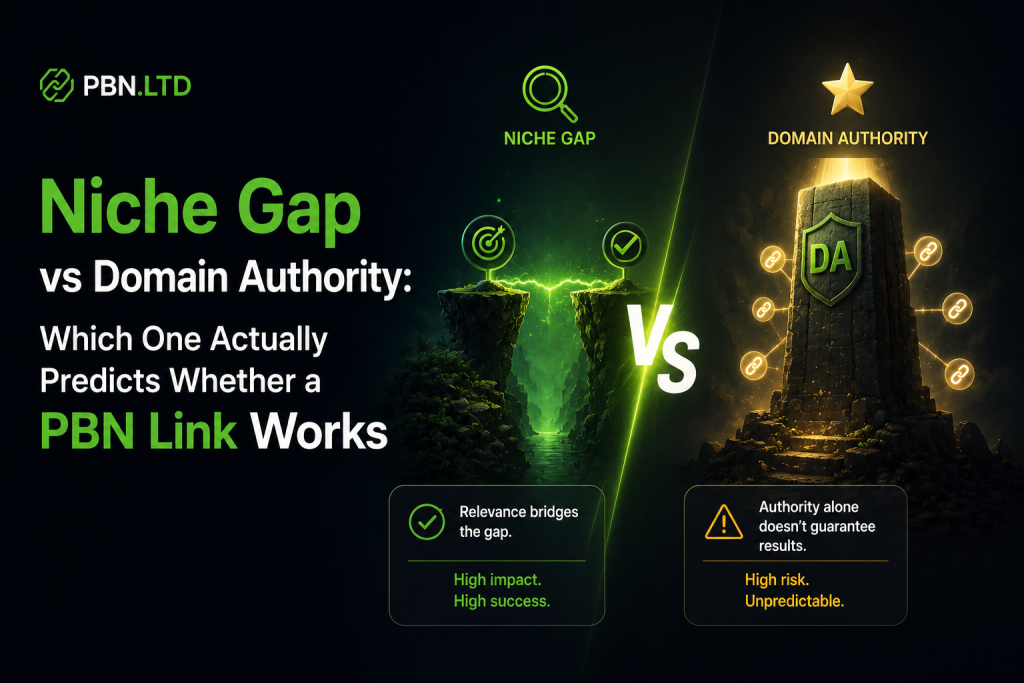
The way most PBN operators evaluate domains before acquisition follows a predictable sequence: check Domain Rating or Domain Authority, look at referring domain count, review Trust Flow, and if the numbers pass a threshold, proceed. Niche relevance — the actual topical relationship between the acquired domain and the money site it will link to — enters the conversation later, if at all. This evaluation sequence is backwards, and it’s the reason why networks built around strong metrics consistently underperform against expectations.
The evidence from both Google’s published guidance and controlled link building research is consistent: a link from a mid-authority site in the money site’s exact niche outperforms a link from a high-authority site in an unrelated niche. The mechanism behind this isn’t complex once it’s understood — but it’s consistently underweighted in the metrics-first evaluation culture that dominates most PBN acquisition decisions. Understanding which domain metrics actually predict PBN link performance requires understanding why the standard metrics don’t fully capture what determines whether a link actually moves rankings.
Why Domain Authority Is a Proxy, Not a Signal
Domain Authority, Domain Rating, and equivalent metrics from Ahrefs, Moz, Semrush, and other tools are third-party calculations designed to estimate domain strength. None of them are ranking factors in Google’s algorithm. They are proxies — attempts to model the underlying signals Google uses, primarily the volume and quality of inbound links, to produce a score that correlates with ranking performance.
The correlation is real but imperfect, and the imperfection matters for link building. A domain can achieve a high DA or DR score through a backlink profile that’s broad but topically scattered — links from hundreds of different sectors, categories, and industries that have collectively built a strong raw PageRank number but haven’t established any particular topical identity. That domain’s high score reflects its position in the web’s link graph globally, not its authority within any specific topic area.
When that high-DA domain links to a money site in a specific niche, it passes PageRank in the aggregate sense — but the topical component of that link’s signal is weak or absent. Google’s systems, which have been evaluating topical relevance of links since the introduction of topic-sensitive PageRank, recognise the difference between a link that comes from within the same topical ecosystem as the money site and one that arrives from outside it. Both links pass some value. They do not pass the same value.
Topic-Sensitive PageRank: The Mechanism That Explains Everything
Google’s original PageRank algorithm treated all links as equivalent in terms of the type of authority they pass — a link was a link, and its value was determined by the linking page’s score and the number of other links on that page, not by what the linking page was about. Topic-sensitive PageRank, which Google began implementing in the early 2000s and has progressively refined since, introduced the concept that authority is topic-specific. A page’s authority within a given topic is determined not just by how many other pages link to it, but by how many topically relevant pages link to it.
The practical consequence is that two domains with identical raw PageRank scores have different effective authority within specific topic areas. A domain that has accumulated its links primarily from other sites in the legal niche has high authority in the legal topic cluster and lower authority in, say, the home improvement topic cluster. A domain with links from across dozens of unrelated categories has moderate authority in many clusters but high authority in none. When either of these links to a money site, the authority they pass is filtered through the topical lens.
This is not a recent development or a speculative interpretation. It’s the mechanism that explains why, consistently across competitive analysis and controlled testing, links from topically coherent sources outperform links from topically distant sources at equivalent authority levels. how topical authority is built and evaluated by Google’s ranking systems from the perspective of how Google’s knowledge graph and semantic analysis layer evaluate sites and the links between them provides the full picture of how this evaluation works in 2026.
Defining the Niche Gap
The ‘niche gap’ between a PBN site and a money site can be thought of as the topical distance between them — how many category steps separate the subject matter of the linking site from the subject matter of the destination. Understanding this spectrum is more useful than thinking in binary terms of ‘relevant’ or ‘irrelevant’.
Zero Niche Gap: Exact Topic Match
A personal injury law firm money site receiving a link from a PBN site whose content is entirely about personal injury law, motor accident claims, and compensation processes. The linking site and the destination site occupy the same topical territory. Every signal Google reads — the content of the linking page, the anchor text, the context around the link, the overall site topic — reinforces the same topical message. This is the highest-value link configuration. A PBN domain at DR 20 with genuine content in exactly this niche, acquired for £80, will pass more effective authority to this money site than a DR 50 domain whose content covers legal topics across family law, corporate law, immigration, and property with a single article about personal injury.
Narrow Niche Gap: Same Sector, Adjacent Topic
A supplement e-commerce money site receiving a link from a PBN site covering fitness, exercise science, and nutrition broadly. The topics are related — someone interested in supplements is likely interested in fitness, and someone writing about nutrition frequently references supplementation. The topical signal is positive and genuine, but less concentrated than a zero-gap link. This configuration still substantially outperforms a high-DA link from an unrelated category. For many money sites, this is the most achievable configuration given the available domain supply in their exact niche.
Medium Niche Gap: Same Broad Category
A cycling equipment retailer receiving a link from a PBN site that covers general outdoor sports, including hiking, running, and various other activities alongside some cycling content. The topical connection exists and is recognisable to Google’s semantic analysis layer, but the signal is diluted by the breadth of topics covered on the linking site. This configuration passes reasonable raw PageRank but weak topical authority reinforcement. The link helps the money site’s overall authority more than its authority specifically within the cycling topic cluster.
Wide Niche Gap: Tangential Connection
A financial services money site receiving a link from a PBN site that covers general business and entrepreneurship topics. There’s a plausible connection — business sites sometimes cover financial topics — but the topical alignment is thin. Google’s semantic analysis will recognise the link as coming from outside the core financial services topic cluster. The link passes raw PageRank and contributes to the money site’s general authority profile, but its contribution to establishing financial services authority is minimal.
Full Niche Gap: No Topical Relationship
A beauty products money site receiving a link from a PBN site covering technology and software. These topic areas don’t share semantic territory in any meaningful way. The link passes raw PageRank — it moves the money site’s general authority score — but it contributes nothing to establishing the site’s authority within the beauty and cosmetics topic space. In a competitive niche where the money site’s competitors are being linked to primarily from topically coherent sources, this configuration’s link value is significantly diminished relative to equivalent-metric links from relevant sources.
What the Research Shows About Link Effectiveness Predictors
A SearchAtlas analysis of backlink placement quality found that a proprietary metric incorporating trust, topical relevance, and link velocity history significantly outperformed both Domain Authority from Moz and Domain Rating from Ahrefs as a predictor of actual ranking improvement. The standard metrics predicted some outcome variation, but the relevance dimension — how topically aligned the linking source was with the target — consistently emerged as the more powerful variable when examined in isolation.
This finding is consistent with controlled testing across competitive niches. Sites targeting competitive keywords in specific verticals consistently show that clusters of topically relevant links at moderate authority levels produce greater ranking improvement than equivalent-count clusters of high-authority links from mixed or unrelated sources. The mechanism is topic-sensitive PageRank — each niche-relevant link reinforces the money site’s position within its specific topic cluster, cumulatively building the kind of topical authority that sustains rankings across algorithm updates.
The March 2026 core update’s reward pattern is illustrative. Sites that held or improved rankings through that update were disproportionately those with ‘specialist destination’ link profiles — links concentrated in their specific niche from sources that themselves demonstrate genuine expertise in that area. Sites that lost rankings despite having strong overall DR scores were more commonly those with broad, topically scattered link profiles that had accumulated raw PageRank without building coherent topical signals.
How This Changes Domain Acquisition Decisions
The practical implication for PBN operators is that domain acquisition evaluation should weight niche relevance at least as heavily as authority metrics, and in many cases more heavily. A domain at DR 18 with a clear, clean history in the specific niche of the money site — genuine prior content, backlinks from other sites in the same topic area, no penalty history — is often a better investment than a DR 35 domain from a generalist blogging background whose prior content covered a dozen unrelated topics. evaluating expired domains for topical relevance alongside authority metrics as a discipline needs to incorporate niche gap analysis as a primary filter, not an afterthought applied to domains that have already passed the metric threshold.
The niche gap assessment for a candidate domain involves examining: the prior site’s content theme as archived in Wayback Machine, the subject matter of the domains that link into it (since Google uses this to assess topical classification), and the semantic distance between that theme and the money site’s keyword targets. A domain that achieved its DR score through links from other sites in the same industry is a different asset from one that accumulated the same score through a scattered acquisition or by being a generalist resource page.
Content Strategy as a Niche Gap Management Tool
One underappreciated lever is using content strategy on PBN sites to narrow the effective niche gap even when the acquired domain’s prior history wasn’t a perfect match. A domain with a broad prior history, rebuilt with content that specifically and consistently covers the money site’s niche, can progressively shift Google’s topical classification of the site over time. This shift isn’t instant — Google’s topic classification model is built on accumulated signals — but it’s real. PBN content that reinforces topical alignment with the money site across the network, consistently aligned with the money site’s niche, actively reduces the effective niche gap as the site’s crawl history accumulates topic-specific content.
The anchor text dimension reinforces this. A link from a PBN site with a medium niche gap, using anchor text that’s specific and relevant to the money site’s exact query targets, produces a better topical signal than the same link with generic anchor text. The anchor text is one of the clearest signals in the linking environment about what relationship the linking site is asserting between itself and the destination.
anchor text choices that amplify topical relevance signals as applied to commercial and competitive keywords is a separate optimisation, but the principle compounds with niche gap analysis: a zero-gap link with highly specific, relevant anchor text is the strongest available topical signal configuration, and each element reinforces the other.
Detection Risk and Niche Gap
The niche gap also has a detection dimension that’s increasingly relevant in 2026. how SpamBrain detects topical misalignment as a network-level signal has developed progressively more sophisticated pattern recognition for networks, including the ability to detect topical misalignment as a network-level signal. A set of PBN sites all linking to the same money site from unrelated niches creates a pattern that looks different from the natural web, where a site accumulating editorial links in its niche tends to receive them from within that niche. The broader the average niche gap across a money site’s PBN link profile, the more detectable the pattern becomes as coordinated rather than organic.
Niche-coherent networks are more resilient to this type of detection not because they’re invisible to Google’s systems, but because their pattern of topical relationships more closely resembles what natural editorial linking looks like. A cybersecurity money site with PBN links coming predominantly from technology, software, and security-adjacent sites looks like a site that’s genuinely valued by its industry. The same site with links from travel, food, and lifestyle sites doesn’t.
Applying Niche Gap Analysis at Scale
For operators managing large networks across multiple money sites, implementing niche gap analysis at scale requires treating the network architecture as topic-specific rather than general-purpose. Rather than maintaining a single pool of PBN sites and directing links from any site to any money site based on authority availability, the more effective approach is organising network sites into topic clusters and maintaining strict niche gap constraints on which sites can link to which money sites.
This means acquiring domains with explicit niche targeting in mind — building a sub-network of sites in the financial niche for financial money sites, a sub-network in health and wellness for supplement and fitness money sites — rather than accumulating general-purpose authority sites and distributing links broadly. PBN sites that establish genuine topical authority within their niche that generate their own organic presence within their niche are the gold standard of this approach: sites Google has independently assessed as genuine resources in a specific topic area, whose links to money sites in the same topic carry the full topical authority signal rather than a discounted version of it.
Operating WordPress PBN hosting for a topic-clustered network architecture requires more planning at setup than a general-purpose pool, but the link effectiveness returns are substantially higher and the resilience across algorithm cycles is meaningfully better. Our PBN building service handles the niche targeting and content alignment across new builds, and free personalised PBN advice is available for operators working through how to restructure existing general-purpose networks into more topically coherent configurations.