After analysing millions of backlinks across thousands of sites, we’ve identified clear patterns that distinguish natural anchor text profiles from manipulated ones—and how to build profiles that look genuinely organic.
Anchor text—the clickable text in a hyperlink—seems straightforward. But it’s one of the most scrutinised elements in Google’s link evaluation. Over-optimised anchor text has been a penalty trigger since the original Penguin update, and Google’s detection has only improved since then.
The challenge is that natural anchor text doesn’t follow simple rules. Real people link in unpredictable ways, and the resulting patterns are messier than most SEOs expect. Understanding the psychology behind how real links get created is essential for building profiles that look authentic.
This guide examines anchor text from a psychological perspective: how people actually link, what natural distributions look like, and how to apply these insights to your link building strategy.
How Real People Actually Create Links
To build natural anchor text profiles, you need to understand how organic links happen. When someone genuinely links to a resource, their anchor text choices are influenced by several psychological factors:
Convenience and Laziness
Most natural links use whatever text is easiest. This often means:
- The page title: People copy/paste because it’s right there
- The URL itself: Especially when sharing links in casual contexts
- The brand name: Because that’s how they think of the site
- Generic phrases: ‘this article,’ ‘here,’ ‘read more’—minimal effort
SEOs optimise for keywords. Regular people optimise for convenience. This fundamental difference explains why manipulated anchor profiles look so different from natural ones.
Context and Flow
When someone links within well-written content, they choose anchor text that fits the sentence structure. The result is often partial matches, descriptive phrases, or contextual references that make sense in the paragraph but wouldn’t be chosen for SEO purposes.
Example: Instead of ‘best coffee grinders,’ a natural link might read ‘this comprehensive guide to choosing home espresso equipment’ because that’s what flows in the sentence being written.
Relationship and Trust Signals
How someone refers to a site often depends on their relationship with it. Regular readers use different language than first-time visitors. Fans use different language than neutral observers. These variations create natural diversity that manufactured links often lack.
Platform and Format Influence
Where a link appears affects anchor text:
- Blog posts: More descriptive, integrated into content
- Forums: Often just URLs or brief descriptions
- Social media: Usually URLs or brand mentions
- Resource pages: Site names or brief descriptions
- News articles: Brand names, sometimes with descriptors
Anchor Text Categories Explained
Understanding anchor text categories helps you analyse and plan your profiles:
| Category | Description | Examples |
| Exact Match | Precisely matches target keyword | “best coffee grinder”, “SEO services London” |
| Partial Match | Contains target keyword plus other words | “guide to choosing a coffee grinder”, “their SEO team” |
| Branded | Uses brand/company/site name | “Nike”, “Ahrefs”, “The New York Times” |
| Branded + Keyword | Combines brand with keyword | “Nike running shoes”, “Ahrefs SEO tools” |
| Naked URL | The URL itself as anchor text | “https://example.com/page”, “example.com” |
| Generic | Non-descriptive call-to-action phrases | “click here”, “read more”, “this site”, “here” |
| LSI/Related | Semantically related but not exact keyword | “espresso equipment” (for coffee grinder page) |
| Image | Image used as link (alt text becomes anchor) | Logo links, banner ads, product images |
What Natural Anchor Distributions Look Like
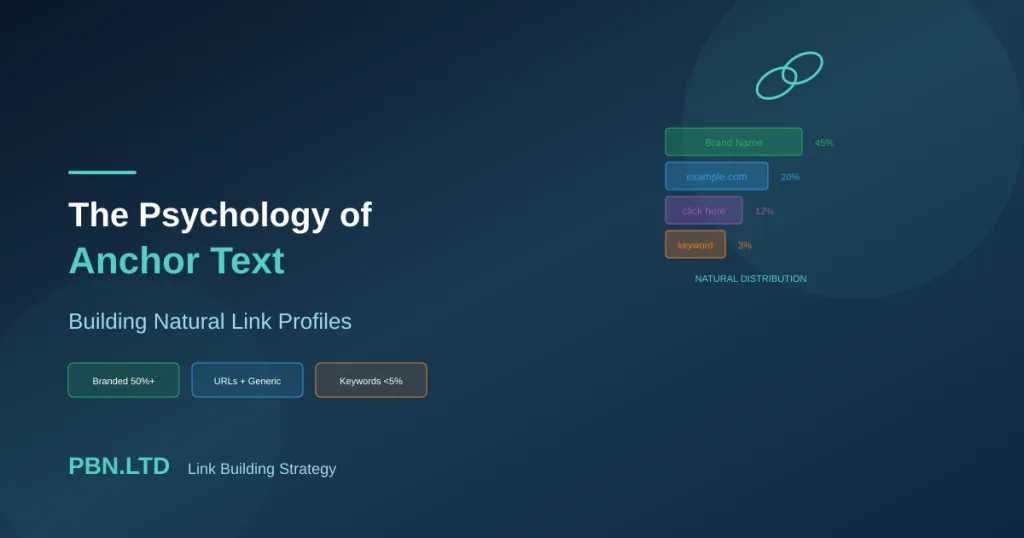
Based on analysis of sites with genuinely organic link profiles, here are typical distribution ranges. Note these are approximations—every site is different, and natural variation is itself a characteristic of authenticity.
Typical Natural Distribution
| Anchor Type | Natural Range | Red Flag Threshold |
| Branded | 30-60% | Under 15% |
| Naked URL | 10-25% | Under 5% |
| Generic | 5-15% | Under 3% |
| Exact Match | 1-5% | Over 10% |
| Partial Match | 5-15% | Over 25% |
| LSI/Topical | 5-15% | N/A – rarely problematic |
| Other/Misc | 5-20% | N/A |
Key insight: Natural profiles are dominated by branded and URL anchors, with keyword-focused anchors being a small minority. This is the opposite of what many SEOs instinctively build.
Building Natural-Looking Anchor Text Profiles
1. Lead with Branded and URL Anchors
Make branded anchors and naked URLs your foundation—at least 50% of your profile. This mirrors how real sites get linked and provides a natural base that dilutes any keyword anchors you do build.
Variations to use: brand name alone, brand name + descriptor (‘Brand blog,’ ‘Brand’s guide’), domain variations (with/without www, with/without https), and partial URLs.
2. Use Keywords Sparingly
Exact match keyword anchors should be rare—1-5% of your profile maximum. Partial matches can be slightly higher but still limited. When you do use keywords, vary them:
- Different word orders
- Singular vs. plural
- With and without stop words
- Embedded in longer phrases
3. Embrace Imperfection
Natural anchor text includes typos, awkward phrasing, and suboptimal choices. A profile where every anchor is perfectly crafted looks manufactured. Include:
- Occasional typos in brand names
- Random phrases that make sense only in context
- Long, awkward anchors that flow from sentence structure
- Generic anchors that add no SEO value
4. Match Anchors to Link Context
The anchor should make sense for where the link appears. A link in a resource list uses different anchors than a link in article body text. A social media mention uses different anchors than a formal citation.
When planning links, consider the context first, then choose anchors that would naturally appear in that context—not the other way around.
Planning link placement and anchor distribution requires coordination across your network. Our management dashboard helps track and balance anchor profiles.
5. Diversify Within Categories
Even within branded anchors, use variety: ‘Brand,’ ‘Brand.com,’ ‘the Brand team,’ ‘Brand’s website,’ etc. The same applies to every category. Repetition of identical anchors—even safe ones—creates patterns.
Anchor Text Strategy for PBN Links
PBN links require extra anchor text consideration because you control them completely—which makes it easy to over-optimise.
Be More Conservative Than You Think Necessary
Because you control PBN anchors, the temptation is to use valuable keyword anchors. Resist it. Your PBN links should follow the same distribution principles as your overall profile—heavy on branded/generic, light on keywords.
If anything, be more conservative with PBN anchors because links from networks are higher risk than genuinely organic links.
Plan Anchors Across the Network
Before placing any links, plan your anchor distribution across your entire network. Don’t decide anchors site-by-site; look at the aggregate picture for your money site and ensure it looks natural.
If you have 20 PBN sites, you might use keyword anchors on only 2-3 of them. The rest use branded, URL, and generic anchors.
Vary Placement Styles
Don’t use the same anchor placement pattern on every PBN site. Vary:
- Where in the content the link appears (beginning, middle, end)
- Whether it’s in-content or in a resource list
- Anchor length (single word to full sentences)
- Whether it’s the only outbound link or among several
Maintaining consistent quality across PBN sites requires proper infrastructure. See how our hosting supports professional PBN management.
Analysing and Fixing Existing Profiles
How to Audit Your Anchor Profile
- Export your backlinks: Use Ahrefs, Semrush, or Majestic to get complete backlink data
- Categorise anchors: Group into branded, URL, generic, exact match, partial match, and other
- Calculate distribution: What percentage falls in each category?
- Compare to benchmarks: Are you within natural ranges?
- Identify problems: Flag any over-optimised patterns
Fixing Over-Optimised Profiles
If your profile is too keyword-heavy, you have options:
- Dilute with new links: Build many more branded/generic anchor links to shift percentages
- Update existing links: If you control the linking pages (e.g., PBN sites), update anchors
- Disavow worst offenders: For obviously spammy links you can’t otherwise address
- Build tier 2 links: Point links at pages that link to you (dilutes direct profile impact)
Dilution is usually the safest approach. Adding natural links is lower risk than modifying or disavowing existing ones.
Frequently Asked Questions
What’s the ideal anchor text for a money site link?
There’s no single ideal anchor—the ideal is a natural distribution. For any individual link, the best anchor is one that fits the context where it appears. Sometimes that’s branded, sometimes generic, occasionally a relevant keyword phrase. Judge each link in context, not isolation.
Should all my links to a page use different anchors?
No—some natural repetition is expected. Many sites get multiple ‘click here’ links or multiple brand name links. What’s unnatural is either perfect uniqueness (every anchor different) or obvious patterns (exactly the same keyword anchor from multiple sites). Natural profiles have some repetition, but with variation.
Do anchor text rules differ for homepage vs. inner pages?
Somewhat. Homepages naturally receive more branded anchors (people link to ‘Brand’ or ‘Brand.com’). Inner pages receive more descriptive anchors related to page content. Both should follow natural distribution principles, but the specific mix shifts based on what type of page would naturally attract links.
How do I handle anchor text for non-English links?
Foreign language anchors are natural if you have an international audience or topic. They become suspicious when an English-only site suddenly has many Chinese or Russian anchors with no logical reason. Match anchor languages to your site’s actual audience and topic.
Does Google penalise for anchor text, or just discount links?
Both can happen. Over-optimised anchor profiles might trigger link devaluation (links just don’t count) or, in extreme cases, algorithmic penalties that actively suppress rankings. Severe manipulation can also attract manual review. The safest approach is avoiding over-optimisation entirely.
Should I include nofollow links in my anchor text planning?
Yes. Nofollow links contribute to a natural profile—real sites get them from social media, forums, and various sources. When analysing your anchor distribution, include nofollow links in the picture. A profile with zero nofollow links would itself be unnatural.
Building Profiles That Last
Anchor text strategy ultimately comes down to understanding how real people create links, then mirroring those patterns in your link building. Real people don’t optimise for keywords. They link with whatever makes sense in context—usually branded anchors, URLs, or generic phrases.
The psychology of natural linking should guide your approach: convenience over optimisation, context over keywords, diversity over patterns. When your anchor profile looks like it could have been built by thousands of independent people making independent linking decisions, you’ve achieved authenticity.
This requires restraint—especially with controlled links like PBNs where the temptation to keyword-stuff is strong. But restraint pays off in sustainable rankings that don’t collapse when Google’s next update arrives.
Manage Anchors Across Your Network
Coordinating anchor text strategy across a PBN network requires visibility and planning tools. PBN.LTD’s management dashboard helps you track outbound links, monitor anchor distribution, and ensure natural patterns across all your sites. Combined with our footprint-free hosting, you get the infrastructure to manage anchor strategy professionally.