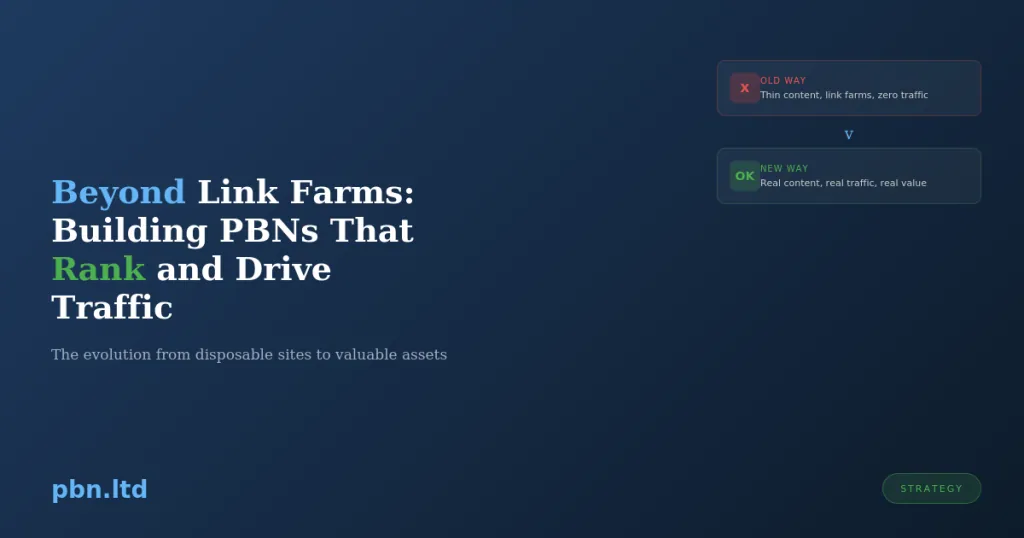
The traditional PBN model is simple: build sites, place links, pass authority to money sites. The sites themselves are means to an end—they exist to hold links, nothing more.
That model still works, but there’s a more powerful approach. What if your PBN sites weren’t just link holders but actual assets? Sites that rank for their own keywords, drive their own traffic, and multiply the value of your network?
This is the evolution from link farms to strategic satellite sites. It requires more investment but delivers compounding returns.
The Satellite Site Concept
Think of your money site as the hub of a wheel. Traditional PBN sites are spokes that point inward, transferring authority but serving no other purpose.
Satellite sites are different. They’re scaled-down versions of your money site—targeting related keyword clusters, serving real visitors, building their own authority. They still link to your money site, but they’re also valuable properties in their own right.
A traditional PBN site about home renovation might have generic articles about kitchen remodeling, bathroom updates, and flooring. It exists to contextualise a link to your renovation company’s website.
A satellite site about home renovation targets specific keyword clusters your money site can’t efficiently reach. Maybe it focuses entirely on DIY bathroom renovations, targeting long-tail queries like “how to retile a shower yourself” and “DIY bathroom vanity installation.” It ranks for these terms, attracts visitors interested in home improvement, and funnels qualified traffic to your money site through contextual links.
Why This Approach Works Better
Links from ranking sites carry more weight. Google evaluates the quality of linking sites. A site that ranks for relevant queries, receives organic traffic, and shows engagement signals is more valuable as a link source than a site that exists only to hold links. The link from your satellite site passes more authority because the satellite site has demonstrated its own authority.
Traffic diversifies your acquisition. When satellite sites rank and drive traffic, some of that traffic converts. You’re not just building links—you’re building additional customer acquisition channels. If your money site faces problems, the satellite sites continue generating business.
The sites look legitimate because they are legitimate. The best disguise for a PBN site is genuine value. Sites that rank, attract visitors, and serve real purposes don’t look like link farms because they’re not link farms. They survive manual reviews. They survive algorithm updates targeting thin content.
Keyword cluster coverage expands your reach. Your money site can only target so many keywords effectively. Satellite sites let you capture keyword clusters that are too tangential for your main site but still relevant to your business. You’re expanding your search footprint across the entire topic space.
The network becomes self-sustaining. Sites that generate traffic can generate revenue—through affiliate links, advertising, or lead capture. This revenue can fund network expansion, making the entire operation more sustainable than networks that only cost money.
Identifying Keyword Clusters for Satellites
Not every keyword cluster deserves its own satellite site. The best candidates have specific characteristics.
Related but distinct from your money site’s core focus. Close enough that links make sense contextually, but different enough that a separate site is justified. If your money site is a general contractor, satellites might focus on specific trades—plumbing, electrical, landscaping—that feed into general contracting projects.
Sufficient search volume to justify the investment. A cluster needs enough searches to generate meaningful traffic. Use keyword research tools to assess aggregate volume across the cluster, not just individual terms.
Achievable competition levels. Satellite sites start with less authority than established properties. Target clusters where you can realistically rank, even if your money site couldn’t compete in the same space.
Clear user intent that connects to your money site. The visitors you attract should have interests that align with what your money site offers. Traffic that can’t convert isn’t valuable beyond the link equity.
Map out the keyword universe around your money site. Identify clusters that represent distinct search intents. Evaluate which clusters could support standalone sites that both rank independently and refer valuable traffic to your main property.
Building Satellites That Actually Rank
Building a satellite site that ranks requires treating it like a real site—because it is one.
Proper on-site SEO. Title tags, meta descriptions, header structure, internal linking—all the fundamentals that help any site rank. Don’t cut corners because it’s a satellite. We’ve covered on-site essentials at https://pbn.ltd/importance-of-onsite-seo-for-your-money-site/ and those principles apply to satellites too.
Topical depth. Cover the keyword cluster thoroughly. Don’t create one page per keyword—build topical authority by covering the subject comprehensively. Internal linking between related pages builds relevance signals. Our guide on topical authority explains this approach: https://pbn.ltd/the-complete-guide-to-topical-authority-how-modern-sites-dominate-serps/.
Quality content. This circles back to what we’ve discussed about content quality. Satellites need content that deserves to rank—helpful, specific, valuable. AI filler won’t cut it for sites expected to compete in search results.
Technical excellence. Fast loading, mobile-friendly, secure, properly crawlable. Core Web Vitals matter. Technical SEO problems that might be tolerable on a simple PBN site become ranking barriers for sites competing seriously.
Their own backlinks. Satellite sites benefit from link building just like any site. This might come from your broader PBN network, from legitimate outreach, or from earning links through quality content. The more authority they build, the more valuable their links to your money site become.
The Traffic Flow Strategy
Once satellites rank and attract visitors, you need a strategy for moving that traffic to your money site.
Contextual content links. The most natural approach. Within helpful content, link to your money site where it genuinely makes sense. “If you’re considering hiring a professional for this project, [our guide to choosing a contractor] covers what to look for.” The link serves the reader while directing them to your main property.
Resource recommendations. Create resource pages or recommendation sections that include your money site among other legitimate options. This is natural for sites offering genuinely helpful information—readers expect to be pointed toward next steps.
Problem-solution bridges. Satellite content often addresses problems. Your money site offers solutions. Create content that thoroughly explains the problem, then bridges to your money site as the solution. The visitor arrives educated and pre-sold.
Email capture. For some satellites, capturing email addresses makes sense. Build a list, nurture relationships, and promote your money site’s offerings to subscribers over time. This extracts more value from traffic than single-visit links.
The key is that traffic flow feels natural. Visitors shouldn’t feel like they’ve been tricked into visiting another site. The satellite provided value, and the money site link is a logical continuation of their journey.
Managing the Expanded Network
Satellite sites require more management than traditional PBN sites because they’re doing more work.
Track rankings and traffic. Monitor how each satellite performs in search. Track which content drives traffic. Identify opportunities for optimization and expansion.
Maintain content freshness. Sites that rank need occasional updates. Outdated content loses rankings. Budget for periodic content refreshes on your best-performing pages.
Handle technical maintenance. Sites receiving real traffic need reliable hosting, current software, and proper security. Our operational advantage post covers how centralised management tools help with this at scale.
Measure and optimise traffic flow. Track how traffic moves from satellites to your money site. Test different linking approaches. Optimise conversion paths based on data.
When Traditional PBNs Still Make Sense
This doesn’t mean every PBN site needs to become a full satellite property. Traditional approaches still have their place.
Niches too small to justify full sites. Some keyword clusters don’t have enough volume to support dedicated satellites. Simple PBN sites make sense for providing contextual links in low-volume niches.
Diversification purposes. Even within a satellite-focused strategy, having some traditional PBN sites adds diversity to your backlink profile. Not every link should come from ranking sites.
Early-stage money sites. When your money site is new and needs foundational links to start ranking, waiting for satellites to build authority might be too slow. Traditional PBNs can provide initial momentum while satellites develop.
Budget constraints. Satellites cost more to build and maintain. If resources are limited, focusing on a few high-quality satellites plus supporting traditional sites might be optimal.
The best networks often combine approaches—strategic satellites for primary keyword clusters, traditional PBN sites for diversification and niche coverage.
The Long-Term View
Building satellite sites is playing a longer game. They take more time to develop and more resources to maintain. But they’re also more durable.
Sites that rank on merit survive algorithm updates that destroy thin networks. Sites that drive real traffic have value even if link algorithms change. Sites that generate revenue justify their ongoing costs.
As Google’s systems get better at identifying manipulation, the gap between “sites that exist for links” and “sites that provide value” will widen. The networks that thrive will be those built on genuinely useful properties, not those relying on staying one step ahead of detection.
The satellite approach aligns your incentives with Google’s. You want sites that rank because ranking sites are more valuable links and more valuable traffic sources. Google wants to rank useful sites. Building useful sites satisfies both.
Whether you build these sites yourself or work with PBN building services like ours, the direction is clear. The future of PBN strategy isn’t just link farms—it’s networks of legitimate, valuable, traffic-generating properties that happen to also provide strategic links. Build toward that future, and your network becomes an appreciating asset rather than a liability waiting to be deindexed.