One morning you check your network and half your sites have vanished from Google. No warning. No manual action notification. Just gone.
We’ve helped customers through these situations more times than we’d like. Each one is painful, but each one teaches something. Here are real post-mortems from PBN disasters—what happened, how we figured it out, and how it could have been prevented.
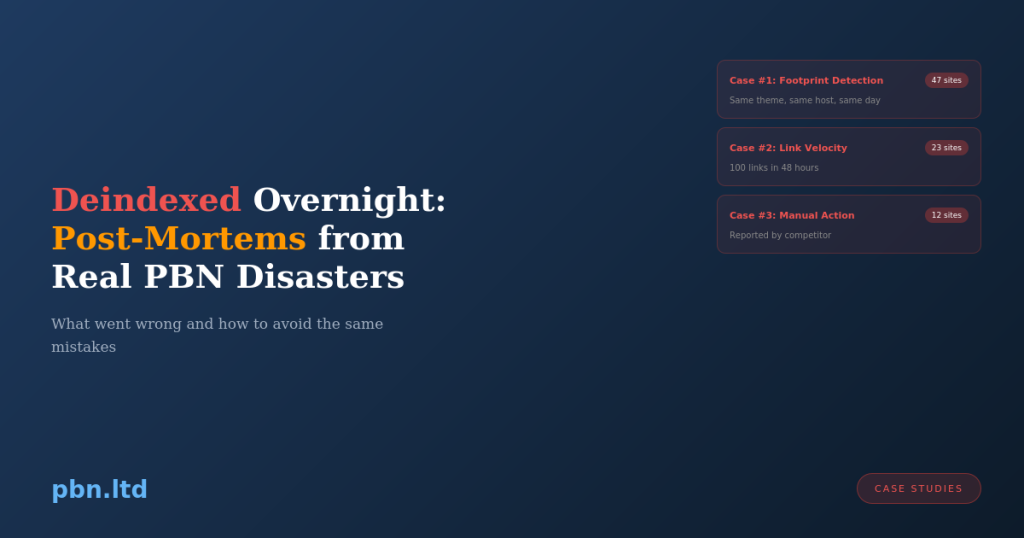
The Shared Hosting Footprint
The situation: Customer had 47 PBN sites. All deindexed within the same week.
The investigation: We looked for common factors. Different domains, different registrars, different content. But all 47 sites were hosted on the same “SEO hosting” provider that advertised unique IPs. We dug deeper. The IPs were technically different, but they all resolved to the same small range of ASNs. All the nameservers followed the same pattern. The SSL certificates were all issued by the same provider on the same dates.
The cause: The hosting provider was running thousands of PBN sites across what looked like diverse infrastructure but was actually heavily concentrated. When Google identified the pattern, everyone on that infrastructure got swept up.
The lesson: Cheap “SEO hosting” that promises unique IPs often delivers superficial diversity. Real footprint protection requires genuine infrastructure diversity—different hosting providers, different ASNs, different nameserver patterns. We’ve written extensively about why proper IP diversity matters at https://pbn.ltd/ip-diversity-explained-understanding-class-a-b-c-and-asn-distribution-for-pbn-hosting/.
Recovery: Partial. Customer migrated surviving sites to properly diverse hosting, but lost significant investment in the deindexed domains.
The Template Fingerprint
The situation: 23 sites deindexed. Customer insisted the sites were on diverse hosting and had unique content.
The investigation: We pulled the source code of each site. They were using the same WordPress theme with minor colour variations. Same plugin set. Same widget configuration. Same footer structure with the same placeholder text in some cases. Same favicon on twelve of them. The HTML structure was identical across all sites.
The cause: The customer had built all sites from the same template, changing only surface-level elements. To a human glancing at them, they looked different. To an algorithm comparing HTML structures, they were obviously related.
The lesson: Diversity needs to go deeper than colour schemes. Different themes, different plugins, different structures. If you’re using templates, vary them genuinely. Our Blueprint system is designed to create starting points that are then customised substantially—not copied identically.
Recovery: Customer rebuilt surviving domains with genuinely different designs. Lost domains were abandoned.
The Link Velocity Spike
The situation: Money site dropped from page one to page six. Several PBN sites linking to it were deindexed.
The investigation: We mapped the link timeline. The money site had been receiving steady links for months—two or three per week. Then, in a single week, 35 new links appeared from the customer’s PBN. All with similar anchor text patterns. All pointing to the same target page.
The cause: The customer had a deadline for a product launch and panicked, firing all their PBN links at once. The sudden spike in links from new domains, all with commercial anchors, all to the same page, was the algorithmic equivalent of waving a red flag.
The lesson: Link velocity matters. Natural link profiles grow gradually. Sudden spikes—especially from domains that haven’t linked to you before—look artificial. Spread your link building over time. Match the pace to what would be natural for your niche. We’ve covered this in depth at https://pbn.ltd/link-velocity-the-science-of-natural-link-acquisition-patterns/.
Recovery: Slow and painful. Money site took four months to recover after the customer disavowed some links and slowed their velocity dramatically.
The Anchor Text Disaster
The situation: Entire 30-site network deindexed over a two-week period.
The investigation: We analysed the outbound links from every site. A pattern emerged immediately. Every site had exactly three outbound links: one to the money site with an exact-match commercial anchor, one to Wikipedia, and one to a major news site. The same structure on all 30 sites.
The cause: The customer had followed advice to “make links look natural” by including links to authority sites alongside their money site links. But doing this identically across all sites created a fingerprint. Three outbound links per page, same ratio, same authority sites, same anchor text approach—it was a signature.
The lesson: Patterns are footprints even when individual elements look natural. Vary everything: number of outbound links, which authority sites you reference, anchor text distribution, link placement. If you can describe your link strategy as a formula that applies to all sites, that formula is a detectable pattern. We’ve covered anchor text psychology at https://pbn.ltd/the-psychology-of-anchor-text-building-natural-link-profiles/.
Recovery: Network was burned. Customer started fresh with new domains and a more varied approach.
The Cross-Linking Web
The situation: 15 sites deindexed simultaneously. Money site rankings dropped but wasn’t penalised directly.
The investigation: We mapped all links between the customer’s properties. Every PBN site linked to every other PBN site. They’d created a dense web of cross-links, thinking it would boost the authority of all sites.
The cause: The cross-linking made the network trivially easy to identify. Find one site, follow the links, find all the others. The interconnected structure screamed “this is a network” to anyone looking—including algorithms designed to look.
The lesson: PBN sites should not link to each other. Ever. Each site should be an island that only links to money sites and legitimate external resources. The moment you create connections between PBN sites, you’re connecting them into an identifiable network.
Recovery: Customer salvaged a few sites by removing all cross-links, but most were too contaminated by association.
The Registrar Paper Trail
The situation: 60+ domains across multiple networks owned by the same person, all deindexed within days of each other.
The investigation: The sites had different hosting, different designs, different content. What they shared was registration data. All domains registered through the same registrar account, with WHOIS privacy that had lapsed on several domains, exposing the same registrant email across multiple properties.
The cause: Once a few domains were exposed as commonly owned, the connection spread. Same registrar account, similar registration dates, same payment method creating similar registrar-side patterns. The ownership footprint was visible to anyone who looked.
The lesson: Domain registration is a major footprint vector. Use multiple registrar accounts. Ensure WHOIS privacy is active and stays active. Vary registration dates. We’ve covered this extensively—registrar privacy should be non-negotiable. See https://pbn.ltd/your-registrar-is-leaking-your-identity-whois-privacy-for-pbn-operators/.
Recovery: Essentially none. The ownership connection was too clear. Customer had to start over with properly separated registration.
The Plugin Payload
The situation: Customer reported all their sites were showing Japanese pharmaceutical spam in Google search results, despite the sites looking normal when visited.
The investigation: Classic cloaking attack. We fetched pages as Googlebot and found hidden content—thousands of spam pages indexed under the customer’s domains. The infection vector was a nulled premium plugin installed across all sites.
The cause: The plugin contained malware that activated weeks after installation, avoiding detection during initial setup. It served spam pages only to search engine crawlers while showing normal content to regular visitors. By the time the customer noticed, the domains were thoroughly poisoned.
The lesson: Nulled plugins and themes will destroy your network. The money you save is nothing compared to what you lose when they inevitably compromise your sites. Pay for legitimate software or use free alternatives. Check what Google sees periodically using Search Console or “site:” searches.
Recovery: Domains were burned. Even after cleanup, Google’s trust was gone. Starting fresh was the only option.
Common Threads
Every disaster shares common elements:
Patterns that seemed invisible were obvious. What feels random when you’re building feels systematic when analysed. Algorithms don’t get tired or bored—they find patterns you didn’t know you were creating.
Shortcuts had costs. Cheap hosting, nulled software, template reuse, bulk link building—every shortcut created vulnerabilities that eventually collapsed.
Detection took longer than expected, then happened suddenly. Networks sometimes operate for months or years before deindexation. This creates false confidence. Then everything goes at once.
Recovery was rarely complete. Once a network is identified, salvaging individual sites is difficult. Starting fresh is usually the realistic path forward.
Building a PBN properly takes more time and costs more money than cutting corners. But networks built properly don’t generate post-mortems. They continue working, quietly, without drama.
If you want help building networks that won’t end up as cautionary tales, our building service and low cost hosting prices are designed around avoiding exactly these disasters. Or review our detailed guide to footprints at https://pbn.ltd/pbn-footprints-to-be-thinking-about/ and build with these lessons in mind.