Manual actions represent Google’s explicit determination that a site violates their guidelines. Unlike algorithmic penalties that happen automatically, manual actions involve human reviewers flagging specific violations. For PBN operators, manual actions on network sites can devastate link value and require careful recovery efforts.
Recovery is possible but not guaranteed. Success depends on understanding what triggered the action, making genuine changes, and submitting convincing reconsideration requests. This guide provides a systematic approach to manual action recovery for PBN sites.
Before diving into recovery, understand that prevention is far better than cure. The effort required for recovery typically exceeds the effort of building properly from the start. Use this guide when necessary, but prioritize practices that avoid manual actions entirely.
Understanding Manual Actions
Manual actions differ from algorithmic impacts in important ways.
Manual vs Algorithmic
Algorithmic impacts happen automatically when sites trigger negative signals in Google’s ranking systems. No human reviews the site. Recovery involves changing what triggers the algorithm, then waiting for recrawling and reevaluation.
Manual actions involve human reviewers at Google examining sites and determining they violate guidelines. These actions are recorded in Search Console. Recovery requires filing a reconsideration request that another human will review.
The distinction matters for recovery strategy. Algorithmic recovery is about changing signals. Manual action recovery is about convincing a human reviewer that violations have been addressed.
Types of Manual Actions Affecting PBNs
Several manual action types commonly affect PBN sites. Unnatural links from your site indicates outbound link manipulation. This directly targets PBN behavior of selling or placing links for ranking purposes.
Pure spam covers sites with no legitimate purpose beyond manipulation. Thin content with affiliate links or doorway pages fall into this category. PBN sites with minimal content exist primarily for link placement and risk this classification.
Thin content with little or no added value targets sites lacking substantive content. PBN sites with sparse, low-quality content are vulnerable. This action does not necessarily indicate link scheme detection but suggests the site provides insufficient value.
Spammy structured markup, cloaking, and other technical violations can also result in manual actions, though these are less common for typical PBN operations.
Identifying Manual Actions
Manual actions appear in Google Search Console under Security and Manual Actions. If you do not have Search Console configured for your PBN sites, you cannot see manual actions directly. This is one reason some operators avoid connecting PBN sites to Search Console.
Without Search Console, manual actions manifest as sudden ranking drops or complete deindexation. Distinguishing manual actions from algorithmic impacts becomes difficult. Site queries returning no results suggest possible manual action.
The decision whether to use Search Console on PBN sites involves tradeoffs. Visibility into manual actions and indexation issues helps management. But Search Console connections create potential footprints and confirm site ownership to Google.
Assessing the Situation
Before attempting recovery, assess whether recovery makes sense.
Is Recovery Worth It
Recovery requires significant effort with uncertain outcomes. For some sites, starting fresh with a new domain may be more efficient than attempting recovery. Consider the domain’s value, the effort required, and probability of success.
High-value domains with strong backlink profiles justify recovery efforts. The accumulated authority represents real value worth preserving. Domains that would be expensive to replace warrant serious recovery attempts.
Lower-value domains with minimal unique authority may not justify recovery effort. If the domain can be easily replaced with another expired domain of similar quality, replacement may be more efficient than recovery.
Understanding the Specific Violation
Manual action notifications specify the violation type but often lack detail about specific issues. You must investigate to understand exactly what triggered the action.
For unnatural outbound links, examine all links from your site. Which links appear manipulative? Paid links, excessive exact-match anchor links, and links to low-quality sites all raise flags. Document every potentially problematic link.
For thin content actions, audit your content objectively. Would this content provide value to users searching for these topics? Does it exist primarily to host links rather than serve readers? Honest assessment guides effective remediation.
Documenting Current State
Before making changes, document the current state thoroughly. Screenshot Search Console data. Export link reports. Archive current content. This documentation proves useful for reconsideration requests and tracking changes.
Create a spreadsheet tracking every issue you identify. Note the problem, its location, and planned remediation. This organized approach ensures nothing is missed and provides evidence of thorough cleanup.
The Recovery Process
Systematic recovery follows clear steps.
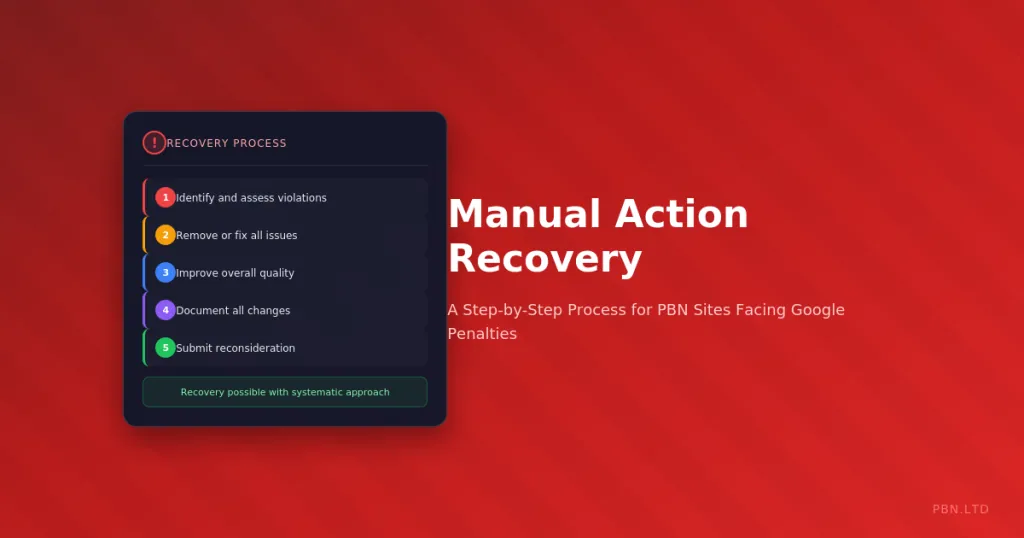
Step One: Remove or Fix Violations
Address the specific violations identified. For unnatural links, remove problematic outbound links or add nofollow attributes. For thin content, either substantially improve content quality or remove thin pages entirely.
Be thorough. Partial cleanup often results in rejected reconsideration requests. Google reviewers may spot issues you missed. Address everything you can identify, then look again for things you might have overlooked.
For PBN sites specifically, this step often requires fundamental changes. Removing all money site links defeats the site’s purpose. You face a choice between genuine cleanup that satisfies Google but reduces site utility, or partial measures that risk rejection.
Step Two: Improve Overall Quality
Beyond addressing specific violations, improve overall site quality. Add substantial, valuable content. Improve site structure and user experience. Make the site genuinely useful rather than merely compliant.
This connects to content quality standards that should have been followed initially. Recovery often requires raising content quality to levels that would have prevented the manual action.
Consider adding pages that serve real user intent. About pages, contact information, and genuinely helpful resources make sites appear more legitimate. These elements should be authentic, not just facades.
Step Three: Document Your Changes
Keep detailed records of every change made. Which links were removed? Which pages were improved? What new content was added? This documentation supports your reconsideration request.
Create before and after comparisons where possible. Screenshots showing removed links or improved content demonstrate genuine effort. Specific details prove you understood and addressed the problems.
Organized documentation also helps if your first reconsideration request is rejected. You can reference previous changes and demonstrate additional improvements in subsequent requests.
Step Four: Submit Reconsideration Request
Reconsideration requests are submitted through Search Console. Write a clear, honest explanation of what happened and what you have done to fix it. Avoid excuses or blame. Accept responsibility and demonstrate remediation.
Be specific about changes made. Generic statements like we removed bad links are less convincing than we identified and removed 47 paid links, added nofollow to 23 affiliate links, and improved content on 12 thin pages.
Explain what you will do differently going forward. Demonstrating understanding of guidelines and commitment to compliance supports your request. Reviewers want confidence that violations will not recur.
Step Five: Wait and Respond
Reconsideration review takes time. Days to weeks may pass before response. Patience is required. Do not submit multiple requests while waiting, as this can delay review.
If the request is approved, the manual action is lifted. Rankings may recover gradually as Google recrawls and reevaluates the site. Full recovery can take additional weeks or months.
If rejected, the response usually indicates remaining issues. Address those issues, make additional improvements, and submit another request. Multiple attempts are sometimes necessary.
Specific Recovery Scenarios
Different manual actions require different approaches.
Unnatural Outbound Links Recovery
This action directly targets link selling or placement behavior. Recovery requires removing or nofollowing links that appear paid or manipulative.
The challenge for PBN operators is obvious. Removing money site links eliminates the site’s purpose. Options include removing all suspicious links and repositioning the site for different use, or accepting that some PBN sites may not be recoverable without defeating their purpose.
If attempting recovery while preserving some utility, focus on links that appear most manipulative. Exact-match anchor text links, links in thin content, and links to obviously commercial pages are highest risk. Natural-appearing links in quality content may survive scrutiny.
Thin Content Recovery
Thin content actions require substantial content improvement. Adding a few paragraphs to existing pages rarely suffices. The site needs genuinely valuable content that serves user needs.
Consider the site’s topic and what users searching that topic would find useful. Create comprehensive content addressing real questions. This is not about fooling reviewers but about genuinely improving value.
Remove pages that cannot be adequately improved. A smaller site with quality content is better than a larger site with thin pages. Quality over quantity applies strongly to recovery.
Pure Spam Classification
Pure spam classification is the most severe and most difficult to recover from. Google has determined the site has no legitimate purpose. Recovery requires transforming the site into something genuinely valuable.
This transformation is extensive. The site needs substantial unique content, legitimate purpose, and clear value proposition. Half-measures almost certainly fail. Full transformation into a legitimate site is required.
For many PBN sites classified as pure spam, replacement is more practical than recovery. The effort required for successful recovery may exceed the effort of acquiring and building a new domain.
Writing Effective Reconsideration Requests
The reconsideration request is your argument for lifting the manual action.
Tone and Approach
Be professional and straightforward. Avoid emotional appeals or complaints about unfair treatment. Accept that violations occurred and focus on remediation. Reviewers respond better to accountability than excuses.
Do not lie or mislead. Claiming you did not know links were problematic when they were obviously paid insults reviewer intelligence. Honesty about what happened, combined with genuine remediation, works better than deception.
Show you understand the guidelines and why your site violated them. This understanding demonstrates that future violations are less likely. Reviewers want confidence that lifting the action will not enable continued abuse.
Structure and Content
Start with a brief acknowledgment of the violation. Then explain specifically what you found during your audit. List the changes made to address issues. Describe improvements beyond minimum compliance. Explain your plans for ongoing compliance.
Include specific numbers and details. We removed 34 links that appeared to violate guidelines is more credible than we removed bad links. Specificity demonstrates thorough work.
Keep requests concise but complete. Reviewers process many requests. Clear, organized submissions are easier to evaluate. Avoid excessive length while including necessary detail.
Common Mistakes
Submitting too quickly before thorough cleanup. Rushing to submit while issues remain results in rejection and delays ultimate recovery. Take time to address everything.
Being vague about changes made. Generic descriptions fail to convince. Specific details demonstrate genuine effort and understanding.
Blaming others or circumstances. Whether you blame previous owners, hired SEOs, or hackers, excuses weaken requests. Focus on current state and remediation rather than how problems originated.
After Recovery
Successful recovery requires ongoing attention.
Monitoring for Recurrence
Sites that have received manual actions may face increased scrutiny. Maintain the improvements made during recovery. Backsliding risks new manual actions that may be harder to lift.
Regular site health monitoring helps catch problems early. Indexation changes, ranking drops, or Search Console warnings deserve immediate attention on recovered sites.
Consider whether to continue using recovered sites for original purposes. A site recovered from an unnatural links action may not be suitable for continued link placement. Changing site purpose may be necessary.
Learning from the Experience
Manual actions indicate what practices triggered detection. Use this information to improve other sites and prevent future actions. What made this site vulnerable? How can you address those factors elsewhere?
Review your network for similar vulnerabilities. If one site received a manual action, others with similar characteristics may be at risk. Proactive improvements prevent reactive recovery. Understanding how detection works helps prevent future problems.
Document the recovery process for future reference. What worked? What did not? This institutional knowledge helps if you face manual actions again.
Prevention is Better Than Recovery
The best approach to manual actions is avoiding them entirely.
Quality Standards
Building PBN sites with genuinely good content reduces thin content and pure spam risk. Invest in quality from the start rather than facing expensive recovery later.
Sites that provide real value to users are harder to classify as spam. Even if the ultimate purpose is link placement, the surface presentation should be a legitimate, useful website.
Link Placement Practices
Careful anchor text strategies and natural link placement reduce unnatural links risk. Aggressive exact-match anchors and links in thin content attract attention. Natural-appearing links in quality content are less likely to trigger manual review.
Moderate link placement frequency. Sites with excessive outbound links relative to content volume appear manipulative. Reasonable link density in substantial content looks more natural.
Footprint Management
Manual reviews often happen because sites are flagged through footprint detection. Proper footprint avoidance reduces the chance of sites being reviewed in the first place.
Sites that avoid detection avoid manual review. Prevention at the detection stage is more effective than hoping to survive review.
Conclusion
Manual action recovery is possible but demanding. Success requires thorough cleanup, genuine quality improvement, and convincing reconsideration requests. The process takes weeks to months with uncertain outcomes.
Evaluate whether recovery makes sense for each affected site. High-value domains justify effort. Lower-value domains may be more efficiently replaced than recovered.
Learn from manual actions to prevent recurrence. The practices that triggered action likely exist elsewhere in your network. Proactive improvement protects remaining sites.
For PBN hosting that supports quality sites less likely to face manual actions, our platform provides the infrastructure and diversity needed for sustainable PBN operations. Build properly from the start to avoid painful recovery processes.