Domain age remains one of the most discussed and most misunderstood factors in SEO. Operators chase aged domains assuming older automatically means better. But the relationship between domain age and ranking power is more nuanced than simple years-since-registration.
Trust signals extend far beyond age. Google evaluates domains through multiple dimensions that together indicate whether a domain deserves authority. Understanding these signals helps PBN operators make better domain acquisition decisions and build more effective networks.
This guide examines what actually matters for domain trust in 2026. We separate facts from myths, explain which signals carry weight, and provide practical guidance for evaluating domains based on real trust indicators rather than superficial metrics.
The Domain Age Myth
Before exploring what matters, let us address the persistent myth that domain age itself drives rankings.
What Google Has Said
Google representatives have repeatedly stated that domain age is not a ranking factor. John Mueller has explicitly said that the date a domain was registered does not impact rankings. The age of the domain registration itself carries no inherent SEO value.
This contradicts widespread belief in the SEO community. Many operators pay premiums for older domains assuming age provides ranking advantage. That assumption is incorrect in its simplest form.
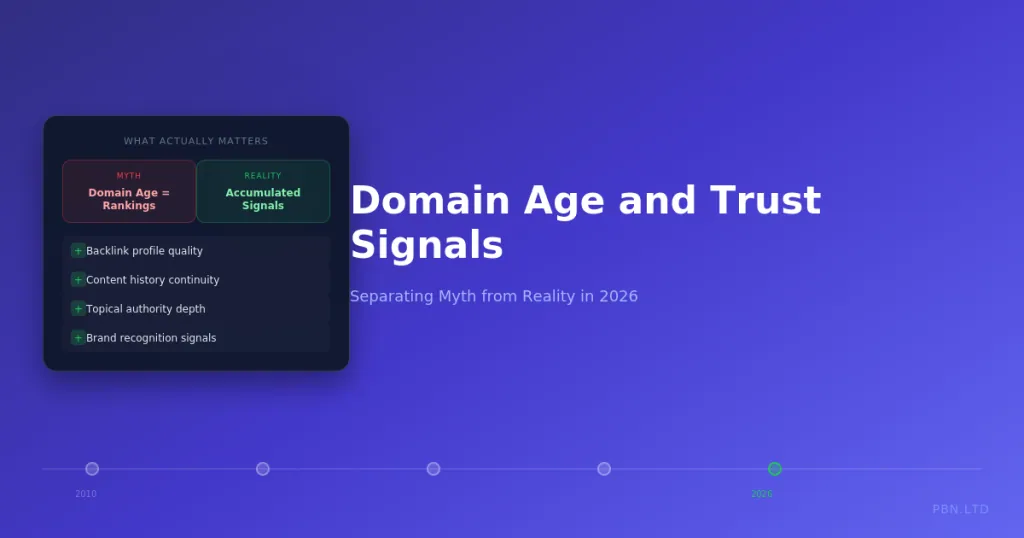
However, the nuance matters. While registration age itself is not a factor, older domains often have accumulated signals that do matter. The age correlation exists but the causation is indirect.
Why the Myth Persists
Older domains frequently outrank newer ones. Operators observe this correlation and attribute it to age. But correlation does not equal causation. Older domains rank better because they have had more time to accumulate the signals that actually matter.
A domain registered in 2005 has had nearly two decades to build backlinks, establish content history, and develop topical associations. A domain registered last year has not. The advantage comes from what happened during those years, not the years themselves.
This distinction matters enormously for PBN operators. Buying an old domain that sat parked for fifteen years provides no advantage over a newer domain. The age without accumulated signals is meaningless.
The Sandbox Effect
New domains often experience what practitioners call the sandbox effect. Newly registered domains may struggle to rank for competitive terms regardless of content quality and link building. This observation is real even if Google denies a formal sandbox.
The practical effect is that brand new domains need time to establish themselves. This creates apparent advantage for older domains. But the sandbox applies to new registrations, not to domains with existing history that change ownership.
Expired domains with existing history typically bypass sandbox effects because they already have established signals. This is part of why expired domains work well for PBNs.
Trust Signals That Actually Matter
Moving beyond age, these signals actually influence how Google evaluates domain trustworthiness.
Backlink Profile Quality
The quality and composition of a domain’s backlink profile remains the primary trust signal. Links from authoritative, relevant sources indicate that the domain has earned recognition from others. This accumulated endorsement translates to trust.
Not all links contribute equally. Links from trusted sources in relevant niches carry more weight than random links from unrelated sites. Understanding how to read backlink profiles helps you identify domains with genuine trust signals versus those with inflated metrics from low-quality links.
Link age within the profile also matters. A domain with links accumulated gradually over years demonstrates sustained relevance. A domain with all links acquired recently might indicate manipulation regardless of domain registration age.
Content History and Continuity
Domains with consistent content history demonstrate sustained purpose. Archive.org snapshots showing regular content updates over years indicate a domain that served real users. This history suggests legitimacy.
Content continuity matters when rebuilding expired domains. Dramatic topic shifts raise flags. A domain that discussed gardening for ten years suddenly becoming a cryptocurrency site appears suspicious. Maintaining topical relevance preserves trust signals.
Gaps in content history are not necessarily disqualifying but should be evaluated. A domain that went dormant for two years before expiring has less continuity than one that was active until expiration.
Topical Authority Development
Google increasingly evaluates domains for topical authority. A domain that has consistently covered a specific topic deeply over time develops authority in that area. This authority is more valuable than generic age.
Topical authority connects to the links a domain has earned. Links from other sites in the same topical area reinforce authority. Links from random unrelated sites do not build topical authority regardless of their raw power.
For PBN purposes, domains with established topical authority in your target niche are more valuable than generically old domains. A five-year-old domain with deep gardening authority beats a fifteen-year-old domain that covered random topics.
Brand Signals
Domains associated with recognized brands carry trust. Brand mentions across the web, branded search queries, and brand-associated citations all contribute to trust signals independent of traditional links.
For expired domains, previous brand recognition may partially transfer. A domain that was a recognized small business in its local area has brand signals that a generic parked domain lacks.
Rebuilding brand signals takes time and effort. The brand associations of the previous owner do not automatically transfer to new content. But the historical brand foundation provides a starting point.
Evaluating Domain Trust for PBN Acquisition
Practical evaluation of trust signals for PBN domain acquisition.
Beyond Third-Party Metrics
Domain Authority, Trust Flow, and similar third-party metrics attempt to quantify trust. These metrics can be useful starting points but should not be the only evaluation criteria. They are approximations based on external observation, not direct measurements of Google’s actual trust assessment.
Metrics can be manipulated. Domains with artificially inflated metrics through link schemes may show high scores while carrying spam penalties or algorithmic suppression. High metrics do not guarantee actual trust.
Use metrics as screening tools, not final decisions. A domain with low metrics might be ignored, but high metrics require deeper verification. The complete domain evaluation process includes steps beyond metric checking.
Archive Analysis
Wayback Machine analysis reveals actual domain history. Check what content existed, how frequently it was updated, and whether the topic remained consistent. This historical analysis provides insights metrics cannot.
Look for red flags in archives. Periods of spam content, pharmacy hacks, or casino injection indicate compromised history. Even if metrics look clean now, historical abuse may have created lingering trust issues.
Positive archive signals include consistent branding, regular content updates, functional contact pages, and evidence of real business operation. These indicators suggest the domain served legitimate purposes.
Link Profile Deep Dive
Beyond aggregate metrics, examine individual links. What sites link to this domain? Are they real websites with their own traffic and purpose? Or are they link farms, PBN networks, or spam sites?
Check link acquisition patterns. Gradual link accumulation over years suggests natural growth. Sudden spikes of links, especially followed by periods of no new links, suggest artificial campaigns.
Anchor text distribution reveals manipulation. Natural link profiles have varied anchor text with heavy emphasis on branded and URL anchors. Profiles dominated by exact-match commercial anchors indicate link building and may carry penalties.
Indexation Status
Check whether the domain is currently indexed. A domain that was deindexed while active carries significant risk. Deindexation suggests manual action or severe algorithmic penalties that may persist after acquisition.
For expired domains, check the last indexed state before expiration. If the domain dropped from the index before it expired, that is a warning sign. If it remained indexed until expiration, that indicates relatively clean standing.
Historical indexation can sometimes be checked through cached results and third-party tools. Understanding a domain’s indexation history helps assess risk.
Trust Signal Preservation
Acquiring a trustworthy domain is only valuable if you preserve those trust signals.
Topical Continuity
Maintain topical relevance when rebuilding expired domains. If a domain covered home improvement, your rebuilt content should relate to home improvement. Dramatic topic shifts waste the topical authority the domain accumulated.
This does not mean exact replication of previous content. You can adapt and evolve the topic. A domain about home renovation can become about interior design. But it should not become about cryptocurrency or weight loss.
Topical continuity also affects link relevance. The backlinks the domain earned were contextually appropriate for the original topic. Changing topics makes those links less relevant and potentially suspicious. This connects to content strategy for PBN sites.
Link Preservation
Existing backlinks point to specific URLs. If those URLs no longer exist, the links become less valuable. Recreating important pages at their original URLs preserves link equity.
Use archive data to identify which URLs attracted links. Rebuild those pages or implement proper redirects. Links pointing to 404 pages waste the trust those links represent.
Not every historical URL needs recreation. Focus on pages with significant links. Lower-linked pages can be ignored or redirected to relevant new content.
Gradual Development
Suddenly publishing hundreds of pages on a recently acquired domain looks unnatural. Real websites develop content gradually. Your rebuilt domain should follow a reasonable publication pattern.
Start with core pages, then expand over weeks or months. This gradual development appears natural and reduces risk of triggering algorithmic review for sudden activity changes.
The same applies to link building. Domains that suddenly start acquiring new links after dormancy raise flags. Gradual resumption of link acquisition appears more natural.
Trust Signals in 2026 Context
How trust evaluation has evolved and what matters now.
E-E-A-T Considerations
Google’s emphasis on Experience, Expertise, Authoritativeness, and Trustworthiness affects how domains build and maintain trust. Domains demonstrating these qualities through content and author signals develop stronger trust profiles.
For PBN sites, E-E-A-T considerations suggest including author information, demonstrating expertise through content quality, and building authority signals within your niche. Generic thin content on aged domains does not leverage available trust effectively.
The bar for trust has risen. What worked for PBN content five years ago may be insufficient today. Higher quality content and better expertise signals are increasingly necessary to maintain trust.
AI Content Detection
As spam detection systems become more sophisticated, trust evaluation incorporates content quality signals more heavily. Domains filled with obviously AI-generated or thin content may lose trust regardless of their historical signals.
This reinforces the need for quality content on PBN sites. Trust signals from domain history provide a foundation, but poor content can erode that foundation. Maintaining trust requires ongoing quality.
User Behavior Signals
Increasing evidence suggests Google incorporates user behavior signals into trust evaluation. Domains that users engage with positively accumulate trust. Domains with high bounce rates and low engagement may lose trust.
For PBN sites, this means creating content worth reading. Even if your primary goal is link placement, content that engages visitors contributes to trust maintenance. Purely thin content that users immediately leave may degrade trust over time.
This connects historical trust to ongoing behavior. A domain with strong historical trust can maintain that trust through continued quality. A domain where user behavior turns negative after acquisition may lose historical advantages.
Practical Trust Assessment
A practical framework for assessing domain trust.
Quick Screening
Start with metric screening to filter candidates. Domains below minimum thresholds for your purposes can be eliminated quickly. This initial filter saves time on detailed analysis.
Check indexation status. Deindexed domains require careful consideration of whether the issues are recoverable. Currently indexed domains start with a cleaner slate.
Scan for obvious red flags. Spammy anchor text profiles, links from known bad neighborhoods, or archive history showing compromised content all indicate problems worth investigating further or simply avoiding.
Deep Analysis
For domains passing initial screening, conduct thorough analysis. Review archive history comprehensively. Examine link profile in detail. Assess topical authority and continuity.
Consider the domain’s story. Can you explain how this domain developed its current profile through legitimate means? If the profile only makes sense as the result of manipulation, trust signals may be artificial and vulnerable.
Evaluate fit with your intended use. A domain with strong trust in gardening may be wasted if you need it for technology content. Trust signals in mismatched niches provide less value.
Risk Assessment
Every domain carries some risk. The question is whether the trust signals justify that risk. Strong trust indicators from legitimate history justify higher prices and higher expectations.
Ambiguous trust signals suggest caution. Domains where trust indicators are mixed or unclear may work but carry higher risk. Price these domains accordingly and maintain lower expectations.
Weak trust signals despite good metrics indicate potential problems. High metrics from suspicious sources are not genuine trust. These domains may fail despite appearing strong on surface evaluation.
Conclusion
Domain age itself is not a ranking factor. What matters are the trust signals that domains accumulate over time. Backlink quality, content history, topical authority, and brand recognition all contribute to trust more than simple registration age.
Evaluate domains based on actual trust indicators rather than surface metrics or age alone. Look for genuine signals of authority developed through legitimate operation. Avoid domains with artificial metrics or problematic histories regardless of age.
Preserve trust signals after acquisition through topical continuity, link preservation, and gradual development. Trust earned over years can be lost through poor rebuilding practices.
For PBN hosting that supports trusted domains, our platform provides the infrastructure needed to maintain and leverage domain trust. Build on solid foundations with hosting designed for serious PBN operations.