
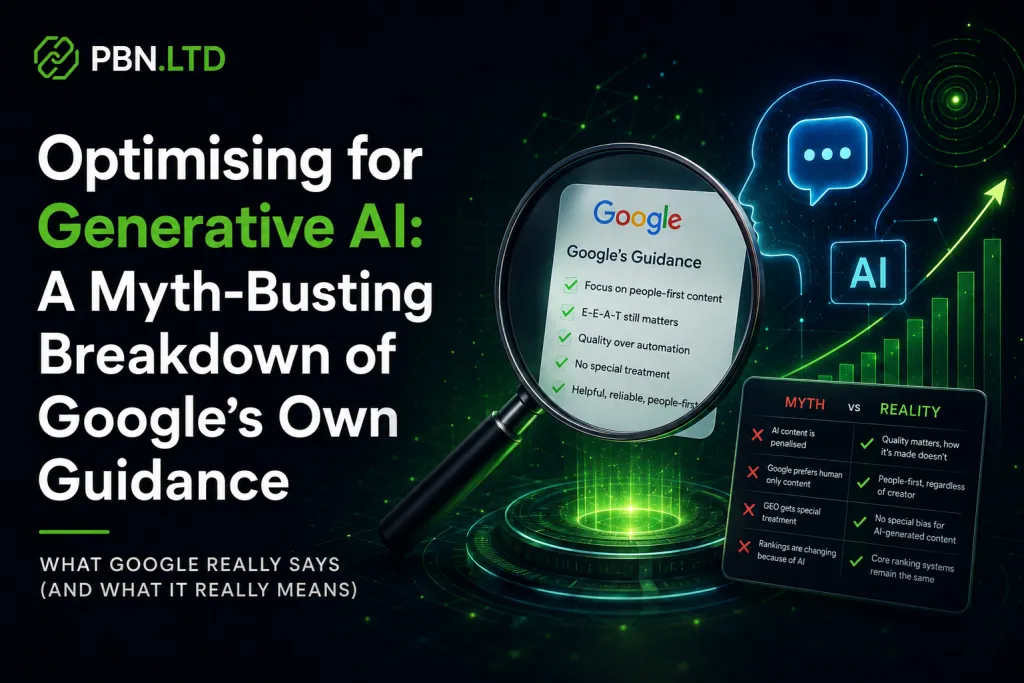
In May 2026, Google published a document a lot of people had been demanding for two years: an official help page titled ‘Optimizing your website for generative AI features on Google Search.’ It covers AI Overviews and AI Mode, and it includes a myth-busting section that named specific tactics the industry has been selling — and called them unnecessary. Predictably, it set off a small war. One camp treated it as total vindication: see, nothing has changed, it was always just SEO. Another camp called it naive and self-serving. Both reactions tell you more about the people having them than about the document.
We’ve read the guidance, we’ve read the smartest responses to it, and we’ve watched how it lines up with what actually happens to sites in AI search. This is our breakdown — not a recap of Google’s document, but an honest sort of what’s genuinely true, what’s true-but-incomplete, and what Google conveniently left out. Because the useful reading of this guidance isn’t ‘Google said it, therefore it’s settled.’ It’s working out where Google is right, where Google is right only about its own back yard, and where you still have to think for yourself.
First, What Google Actually Said
Strip away the noise and the document makes a handful of clear claims. The central one is that AI Overviews and AI Mode are not separate systems bolted onto Search — they are built on the same core ranking and quality systems Google has always used. In Google’s own framing, optimising for generative AI search is optimising for the search experience, and is therefore still SEO. The acronyms the industry invented — AEO (Answer Engine Optimisation), GEO (Generative Engine Optimisation) — are named directly and folded back into plain SEO.
Mechanically, Google explained two things powering AI Overviews. The first is retrieval-augmented generation, or RAG: the AI pulls relevant, current pages from Google’s existing search index rather than inventing answers from its training data. The second is query fan-out: for a single search, the system generates a cluster of related concurrent queries and gathers results for all of them. Both details matter, and we’ll come back to why.
Then comes the myth-busting section — the part that made people angry. Google named five tactics you can ignore for its generative AI features:
- Machine-readable files like llms.txt: Google does not reference an llms.txt file when generating AI Overviews. It may crawl the file like any other page, but it isn’t treated specially.
- Content chunking: There is no requirement to break content into tiny pieces and no ideal page length. Google’s systems understand multiple topics on a single page.
- AI-specific content rewriting: Rewriting your content specifically for AI consumption is unnecessary, and Google’s quality systems can treat it as low-effort.
- Special schema or Markdown versions of pages: Structured data is not required for generative AI search inclusion. Keep it for rich results, but it is not an AI-citation hack.
- Inauthentic ‘mentions’: Seeking manufactured brand mentions to influence what AI says about you is unlikely to help, because the AI features rely on the same spam-fighting systems as core ranking.
Google’s stated conclusion: the single biggest long-term lever for generative AI visibility is valuable, non-commodity content with genuine first-hand expertise, sitting on a technically clean, indexable site. If that sounds familiar, it should — it’s the same thing Google has said about ranking for years, and it’s the same principle behind content that earns its place rather than existing purely to host a link.
Where Google Is Simply Right
Let’s give the document its due, because a fair chunk of it is correct and worth internalising.
AI Overviews Run On The Index — So Indexation And Ranking Still Decide Everything
The RAG detail is the most important practical fact in the entire document, and it’s genuinely true. If AI Overviews retrieve from Google’s existing index, then a page that isn’t indexed cannot be cited, and a page that ranks poorly is far less likely to be pulled into an answer. There is no secret AI back door that bypasses the ordinary work of being crawled, indexed, and ranked. For anyone hoping ‘AI search’ was a fresh start where their unranked site could leapfrog established competitors, it isn’t. The AI is reading from the same library, and that library is still ordered by the same systems.
The Five Debunked Tactics Are Mostly Snake Oil For Google Search
On the narrow question of getting cited inside Google’s AI Overviews and AI Mode, the five debunked tactics really are a waste of time. Nobody serious has produced evidence that bolting an llms.txt file onto a site moves its AI Overview citation count. Chunking your content into bite-sized fragments for a parser that already understands full pages is busywork. And rewriting pages into stilted ‘AI-friendly’ prose is, if anything, counterproductive — Google’s quality systems are tuned to spot low-effort content, and writing visibly for a machine is a tell, not a tactic. Anyone who sold these as the path to AI visibility over the past 18 months was selling a product Google says doesn’t work.
Query Fan-Out Confirms What Topical Operators Already Knew
The query fan-out mechanic quietly validates an approach good operators have used for years. If a single search spawns a cluster of related queries, then visibility depends on being relevant across a whole topic, not a single keyword. That is topical authority by another name — covering a subject with genuine breadth and depth rather than chasing one phrase. It is the same lesson how a decade of algorithm updates moved Google toward understanding meaning over keywords, where the trajectory has consistently been away from matching keywords and toward understanding topics and intent. Fan-out is the AI-era expression of a very old direction of travel.
Where Google Is Right — But Only About Its Own Back Yard
Here’s the wrinkle the ‘nothing has changed’ camp skated straight past, and it’s the single most important caveat in this whole discussion. Every one of Google’s debunkings is scoped to Google Search. ‘Wrong for Google’s AI Overviews’ is not the same statement as ‘wrong for AI in general.’
The llms.txt Question Isn’t As Closed As Google Implies
Take llms.txt. Google says it ignores the file, and for Google Search that’s the end of it. But Google Search is one ecosystem among several. Other AI systems — including some assistants and agent platforms that have explicitly committed to reading machine-readable documentation files — may consume an llms.txt where Google does not. The honest version of the guidance would be: ‘Google doesn’t process llms.txt in any special way; other systems may, and the deployment data is still thin.’ Telling people to ignore a file purely because Google ignores it is single-platform thinking dressed up as universal advice. It might be the right call for you, it might not — but it’s a testing decision, not a closed case, and Google’s framing quietly erases that nuance.
Citation Engines Are Not All Google
This generalises. ChatGPT, Perplexity, Claude, Microsoft’s Copilot and Gemini’s own app run their own retrieval, their own source preferences, and their own ranking of what to cite. A growing share of the queries that used to start on Google now happen inside these tools, which is part of the broader traffic story we covered in what the clickstream data shows about AI Overviews and falling click rates. Optimising only for Google’s AI surfaces because Google published a document about them is exactly the myopia worth avoiding. Google’s guide describes one back yard accurately. Your visibility increasingly depends on several. The discipline of being genuinely authoritative and well-structured travels across all of them; the specific ‘Google ignores X’ rulings do not.
Where You Should Treat Google’s Guidance With Healthy Suspicion
Now the part the ‘it’s all just SEO’ crowd really doesn’t want to hear. Google’s public guidance and Google’s internal reality have a documented history of not matching. Two years ago the industry spent weeks combing through thousands of pages of leaked internal Search documentation, and the recurring theme was that the public advice was, at best, a simplified and self-serving version of how the systems actually behaved. That doesn’t make this document a lie. It does mean ‘Google said so’ is not the trump card some people are treating it as.
There’s also an obvious incentive problem. It serves Google for everyone to believe that nothing has changed, that no new effort is required, and that the answer is simply to keep making good content and trust the machine. A search ecosystem where site owners stop trying to understand the mechanics and just produce content for Google to ingest — frequently to be summarised in an AI Overview that never sends a click — is a very convenient ecosystem for Google. The advice to ‘just make great content and don’t worry about the AI layer’ is true as far as it goes, and also happens to be exactly what Google would say whether or not it was the whole story.
The genuinely uncomfortable backdrop is that being cited in an AI Overview is not the same as getting a visitor. A site can do everything in Google’s document correctly, get pulled into the AI answer, and still lose the click to the summary sitting above the organic results. That tension — visibility without traffic — is the real strategic problem of 2026, and it’s the subject of what zero-click search means for PBN strategy in 2026. Google’s optimisation guide is silent on it, which is understandable: it’s not in Google’s interest to dwell on the fact that winning its AI game can still mean losing the visit.
What This Actually Means For PBN Operators
Cut through all of it and the implications for network operators are clear, and mostly reassuring.
Your Job Hasn’t Changed, Because It Was Never The Gimmicks
If your network sites are genuinely indexed, genuinely topical, and genuinely useful enough that Google ranks them, they are already eligible for whatever AI features draw on that index. You do not need to retrofit llms.txt files, chunk your articles, or rewrite everything in robotic answer-blocks across a network of sites. That’s a relief operationally — those tactics would have been a significant footprint risk applied at scale anyway, a suspiciously uniform technical signature across dozens of sites. The thing that works is the thing that always worked: sites that look and read like real, independent web properties.
Non-Commodity Content Is The Whole Game — And It’s Getting Harder To Fake
Google naming non-commodity, first-hand-experience content as the biggest long-term lever has a sharp edge for PBN operators. The cheap, generic, lightly-spun article that says nothing original is precisely the commodity content these systems are designed to pass over — for ranking and for AI citation alike. The bar for content that reads as genuine rather than manufactured for ranking has risen accordingly. This is also why mass-produced AI filler is a growing liability rather than a shortcut, a theme we’ll keep returning to. Content that demonstrates a genuine point of view, real specifics, and actual expertise is the only kind that clears the bar in both the organic results and the AI layer.
Technical Hygiene And Honest Link Patterns Still Matter
The ‘clean, indexable, semantic HTML’ part of Google’s guidance is just good site building, and it applies to network sites as much as money sites. So does the warning about inauthentic mentions: manufactured signals designed to game the system are exactly what Google’s spam systems — the same systems the AI features depend on — are built to catch. The equivalent discipline on a PBN is making the network behave like the real web, including linking out to genuine authorities the way a real site does rather than pointing every site at one commercial target and nothing else. The principle Google is gesturing at — authenticity over manipulation — is the same principle that separates a durable network from a disposable one.
The Honest Summary
Google’s generative AI guidance is a genuinely useful document that is also, in places, conveniently incomplete. Read it like this. Believe it when it tells you AI Overviews run on the index, that ranking and indexation still decide your eligibility, and that the five debunked gimmicks are a waste of effort for Google Search — all of that is true and worth acting on. Add a mental asterisk every time it says ‘you don’t need X,’ because that ruling is about Google’s own surfaces, and the wider AI ecosystem doesn’t always follow Google’s rules. And keep a healthy scepticism about any Google advice whose practical effect is ‘stop trying to understand the machine and just feed it content,’ because that has always been the most convenient possible message for Google to send.
The throughline, as ever, is that there is no shortcut that substitutes for being genuinely good. Not in the organic results, not in the AI layer, not anywhere. Build sites that deserve to rank, write content that a real expert would be happy to put their name to, keep the technical foundations clean, and you are optimised for generative AI search by default — no acronym required. For the bigger strategic picture on where AI is taking search, we track every twist in our ongoing Google algorithm update coverage, the fundamentals are laid out in the complete PBN guide for 2026, and if you want to talk through how any of this applies to your specific network, free personalised SEO and PBN advice is available.