Internal linking is one of the most underutilised ranking factors in SEO. We’ve restructured hundreds of sites and consistently seen significant ranking improvements from architecture changes alone.
Most SEOs obsess over backlinks while ignoring something equally powerful that’s entirely within their control: internal linking. The way you structure your site and connect your pages directly impacts how Google understands, crawls, and ranks your content.
Unlike external link building—which requires outreach, relationships, or investment—internal linking costs nothing and can be implemented immediately. Yet many sites have chaotic internal structures that actively harm their rankings.
This guide explains how internal linking affects rankings, the architecture principles that maximise SEO performance, and practical strategies for optimising your site structure—whether you’re building money sites or PBN networks.
Why Internal Linking Matters for Rankings
Internal links serve multiple critical functions in SEO:
PageRank Distribution
Google’s original PageRank algorithm calculated page importance based on links. While the algorithm has evolved significantly, the core principle remains: links pass authority. Internal links distribute the authority your site earns from external backlinks to your individual pages.
A page with no internal links pointing to it receives no internally-passed authority, regardless of how strong your domain is overall. Conversely, pages with many internal links from important pages accumulate authority that helps them rank.
Crawl Path Control
Googlebot discovers pages by following links. Your internal linking structure determines which pages get crawled, how often, and in what priority. Pages buried deep in your architecture with few internal links get crawled less frequently—and may not get indexed at all.
Strategic internal linking ensures your most important pages are easily discoverable and frequently crawled.
Contextual Relevance Signals
Internal links with descriptive anchor text help Google understand what the target page is about. When multiple pages link to a page using consistent, relevant anchor text, it reinforces the topical signals for that page.
This is essentially internal anchor text optimisation—and unlike external anchor text, you have complete control over it.
Topical Relationship Mapping
Google uses internal linking patterns to understand how your content relates. Pages that frequently interlink are understood as topically connected. This supports topical authority by showing Google that your site covers a subject comprehensively with interconnected content.
For more on building topical authority through content strategy, see our complete guide to topical authority.
Site Architecture Fundamentals
The Flat vs. Deep Debate
Site architecture is often described by depth—how many clicks from the homepage to reach any page. The conventional wisdom favours flat architecture where most pages are reachable within 3-4 clicks.
| Architecture Type | Advantages | Disadvantages |
| Flat (2-3 clicks) | Easy crawling, authority distributed broadly, fast user access | Can dilute focus, harder to establish hierarchy, navigation complexity |
| Deep (5+ clicks) | Clear hierarchy, concentrated authority on key pages | Crawl issues, orphaned pages, authority not reaching deep pages |
| Balanced (3-4 clicks) | Best of both: hierarchy with accessibility, efficient authority flow | Requires careful planning and maintenance |
For most sites, a balanced architecture of 3-4 clicks maximum works best. Critical pages should be reachable in 2 clicks; supporting content can be 3-4 clicks deep.
The Hub and Spoke Model
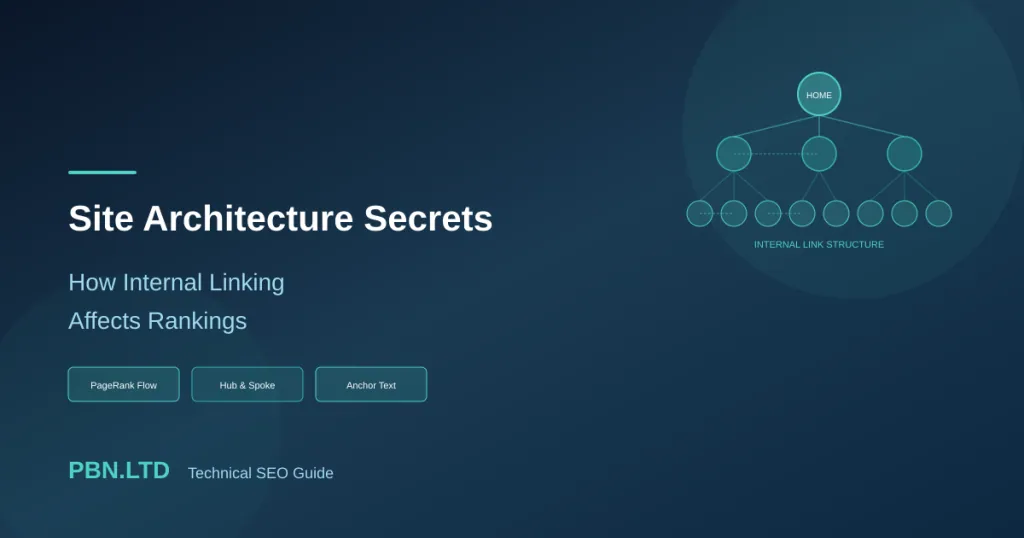
One of the most effective architecture patterns is hub and spoke (also called pillar and cluster). In this model:
- Hub pages (pillars) are comprehensive guides on major topics. They target competitive head terms and link out to related content
- Spoke pages (clusters) are detailed articles on specific subtopics. They target long-tail keywords and link back to their hub
- Cross-linking between spokes within the same cluster strengthens topical associations
This model concentrates authority on your pillar pages while supporting them with comprehensive coverage that demonstrates topical expertise.
Siloed Architecture
Siloing takes hub and spoke further by limiting cross-links between different topic areas. Content within a silo (topic cluster) links freely internally but minimises links to other silos.
The theory is that this concentrates topical relevance signals within each silo. In practice, strict siloing can be overly restrictive. A moderate approach—favouring within-silo links while allowing logical cross-silo links—often works best.
Types of Internal Links
Not all internal links are created equal. Different link types serve different purposes:
Navigational Links
Links in your header, footer, and sidebar navigation. These appear site-wide and pass authority to every page they link to. Use them strategically for your most important pages—but be selective, as adding too many dilutes the value of each.
Contextual Links
Links placed within your content body. These are the most valuable internal links because they:
- Appear in relevant context that reinforces topical relationships
- Use natural anchor text that signals page topic
- Receive user clicks, passing engagement signals
- Aren’t duplicated across every page (unlike navigation)
Related Post Links
Automatically generated ‘related posts’ sections. These can help with internal linking at scale, but they’re less valuable than manual contextual links because the relationship is algorithmic rather than editorial.
Breadcrumb Links
Navigation showing the user’s location in site hierarchy (Home > Category > Subcategory > Page). Breadcrumbs help users and reinforce your site structure for Google. Implement them with proper schema markup for maximum benefit.
Strategic Internal Linking Practices
Link to Your Priority Pages
Identify your most important pages—those targeting your highest-value keywords—and ensure they receive abundant internal links. Every relevant piece of content should link to these priority pages.
Audit your current structure: how many internal links point to your most important pages? If the answer is fewer than your less important pages, you have an architecture problem.
Use Descriptive Anchor Text
Unlike external links where varied/natural anchor text is important, internal anchor text should be descriptive and consistent. Use anchors that clearly indicate what the target page is about.
| Good Anchor Text | Poor Anchor Text |
| “our complete guide to keyword research” | “click here” |
| “learn more about on-page SEO techniques” | “read more” |
| “WordPress hosting for PBN sites” | “this page” |
| “expired domain evaluation checklist” | “here” or “link” |
Link from High-Authority Pages
Pages that receive the most external backlinks have the most authority to pass. Identify these pages and ensure they link to your priority content. A single internal link from your most-linked page is worth more than dozens from orphan pages.
Avoid Orphan Pages
Orphan pages have no internal links pointing to them. They’re essentially invisible to your internal link equity flow and may struggle to get indexed or rank. Every page should have at least one—preferably multiple—internal links.
Regular audits using tools like Screaming Frog can identify orphan pages for remediation.
Fix or Remove Dead Links
Internal links pointing to 404 pages waste crawl budget and create poor user experience. Regularly audit for broken internal links and fix them—either by restoring the target page, redirecting, or updating the link.
Internal Linking for PBN Sites
The same principles apply to PBN sites, with some specific considerations:
Build Like a Real Site
PBN sites should have natural internal linking that mirrors legitimate websites. This means:
- Proper navigation linking to main categories and important pages
- Contextual links within content connecting related articles
- Logical site structure that makes sense for the niche
- No orphan pages (except the money site links shouldn’t be the only links)
A PBN site with only outbound links to money sites and no internal linking looks exactly like what it is: a link farm.
Surround Money Site Links Naturally
When linking to your money site, ensure that link exists within a context of natural internal and external links. A post that only contains your money site link is suspicious. A post that links internally to related content and externally to relevant resources—with your money site link fitting naturally among them—appears editorial.
Building PBN sites properly requires both good structure and proper hosting. Learn about our footprint-free PBN hosting.
Vary Internal Structures Across Network
If all your PBN sites have identical internal linking structures, that’s a footprint. Vary your approach across sites—different navigation styles, different internal linking densities, different content organisation. Each site should feel like it was built independently.
Common Internal Linking Mistakes
| Mistake | Why It’s a Problem | Solution |
| Too many nav links | Dilutes value passed to each page | Limit to essential pages; use dropdowns strategically |
| Generic anchor text | Misses topical relevance signals | Use descriptive, keyword-relevant anchors |
| Orphan pages | No authority flow, crawl issues | Audit and add internal links to every page |
| Over-linking | Looks unnatural, poor UX | Link where genuinely useful; quality over quantity |
| Ignoring deep pages | Valuable content doesn’t get authority | Link from high-authority pages to deep content |
| No structure planning | Chaotic architecture, inconsistent linking | Plan structure before building; document and follow rules |
Auditing Your Internal Link Structure
Regular audits ensure your internal linking remains optimised as your site grows:
Tools for Internal Link Auditing
- Screaming Frog: Crawls your site and maps internal links, identifies orphans, finds broken links
- Ahrefs Site Audit: Identifies internal linking opportunities and issues
- Google Search Console: Shows internal links report (though limited)
- Sitebulb: Visualises site architecture and link flow
Key Audit Questions
- Do your priority pages have the most internal links?
- Are there orphan pages with no internal links?
- Is your deepest content more than 4 clicks from homepage?
- Are there broken internal links?
- Is anchor text descriptive or generic?
- Do pages receiving external links link out to key internal pages?
Frequently Asked Questions
How many internal links should a page have?
There’s no fixed number—it depends on content length and context. A 3,000-word guide might naturally have 15-20 internal links; a 500-word post might have 3-5. The key is that links should feel natural and useful. If you’re forcing links that don’t fit, you have too many.
Should I use nofollow on any internal links?
Generally no. Nofollow prevents PageRank flow, so using it on internal links wastes potential authority distribution. Some SEOs nofollow links to login pages or low-value pages, but this ‘PageRank sculpting’ is less effective than it once was. In most cases, just let all internal links pass value.
Do internal links from the footer count?
Yes, but likely with reduced weight. Google recognises that footer links (and sidebar links) are navigational and appear site-wide. They still pass some value, but contextual links within content are more powerful. Don’t rely solely on footer links for important pages.
Should I link to the same page multiple times from one article?
Google traditionally counted only the first link to a page from any given page. While this may have evolved, there’s no benefit to excessive linking to the same target from one article. One or two well-placed links is sufficient.
How often should I audit internal links?
For active sites, quarterly audits are reasonable. After major content additions, run a quick audit to ensure new pages are properly linked. Sites with less frequent updates can audit semi-annually. The key is consistency—regular audits catch problems before they compound.
Can internal linking alone improve rankings?
Yes, though it works best alongside other factors. We’ve seen significant ranking improvements from internal linking restructures alone—particularly for sites with poor existing architecture. It’s one of the highest-ROI SEO activities because it’s entirely within your control and costs nothing but time.
Building Architecture That Ranks
Internal linking is SEO you completely control. While external link building depends on others, internal architecture is yours to optimise. The sites that rank consistently well almost always have thoughtful internal structures that maximise the value of every page and every backlink.
Whether you’re building money sites, PBN networks, or any web property, invest time in architecture. Plan your structure before building. Link strategically to priority pages. Use descriptive anchor text. Audit regularly.
The principles are simple. The execution requires discipline. But the ranking rewards make it one of the most valuable investments you can make in any site.
Structure Your Network for Success
Proper internal linking on your PBN sites makes them more effective and more natural-appearing. But architecture is only part of the equation—you also need hosting infrastructure that doesn’t create footprints across your network. PBN.LTD provides the technical foundation that lets your carefully-built sites perform safely and effectively. Explore our hosting platform.