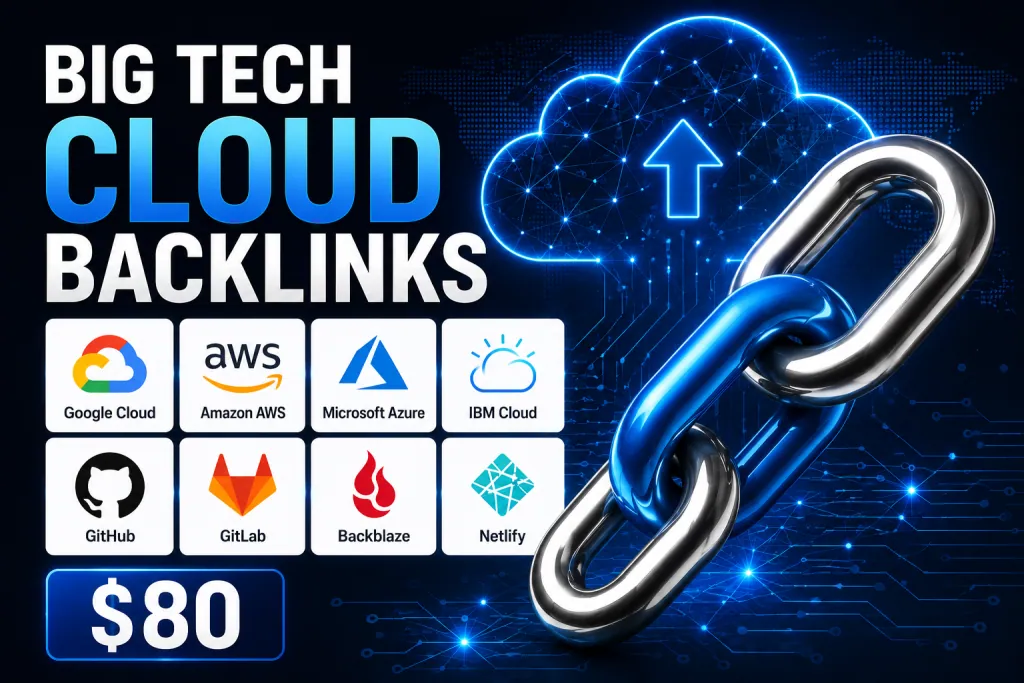
When Google’s crawler hits a page on cloud.google.com, aws.amazon.com or azure.microsoft.com, something interesting happens at the algorithmic level. These aren’t just high-DA domains — they’re infrastructure that Google itself runs on, that powers a meaningful portion of the live web, and that has effectively unlimited crawl priority. A backlink from one of these platforms is interpreted differently from a backlink on a regular content site, and the SEO operators who figured this out a few years ago have been quietly using it to build trust foundations that look completely natural in a backlink audit.
This service is a manually built backlink stack across eight of the most-trusted cloud and developer platforms on the internet. One order. Eight contextual dofollow links. Real assets created on real platforms with custom content for each, internally linked together to compound the authority signal. The whole stack runs $80 — which works out to $10 per link from infrastructure most of your competitors can’t get a link on at all.
The Eight Platforms
Google Cloud cloud.google.com Google’s own infrastructure. Crawl trust at the maximum end of the scale — these pages are indexed near-instantly and weighted heavily. | Amazon AWS aws.amazon.com The default cloud platform for an enormous chunk of the modern web. Authority signals here propagate through Amazon’s ecosystem. | Microsoft Azure azure.microsoft.com Microsoft’s enterprise cloud. Sits behind a significant portion of Fortune 500 infrastructure, with corresponding domain authority. |
IBM Cloud cloud.ibm.com Enterprise hybrid cloud platform. Old-school authority — IBM has been an internet name longer than most domains have existed. | GitHub github.com The default home of open-source code on the internet. Microsoft-owned, ranked aggressively by Google, and trusted implicitly by AI systems. | GitLab gitlab.com The serious open-source alternative to GitHub. High-authority developer platform with strong topical relevance for tech-adjacent niches. |
Backblaze backblaze.com Cloud storage and backup platform with engineering blog credibility and a clean authority profile across DA tools. | Netlify netlify.com Modern web platform powering an enormous slice of the JAMstack ecosystem. High developer trust, high DA, fast indexing. | |
Why These Specifically — And Not “Just More DA 50+ Sites”
The link-building industry has spent fifteen years training operators to think in terms of DA, DR and TF — abstract metrics calculated by third-party tools. Those metrics are useful proxies, but they miss something that matters more in the post-AI search era: the difference between a site that has authority and a site that generates authority for everything it touches.
Google Cloud is not just a DA 95 domain. It’s a platform Google runs internal services on. Its content gets crawled with priority that no third-party site can match. AWS isn’t just trusted by Google’s ranking systems — it’s trusted by the LLMs that increasingly mediate what users discover, because the same authority signal that ranks a page also influences which sources AI systems cite when generating answers. That second-order effect is becoming the dominant reason to care about backlinks at all, and it’s covered in depth in our piece on how SpamBrain and modern AI evaluation systems weight source authority.
The platforms in this stack aren’t interchangeable with “any high-DA cloud blog.” They were chosen because they pair domain authority with platform trust — the rarest combination available in editorial backlink building. A DA 60 marketing blog and a page on cloud.google.com both produce a backlink. Only one of them moves the needle in AI-era search.
The Build, Step By Step
Every link in this stack is manually created. There’s no automation, no scraped account list, no template-and-replace content generation. The process for each platform:
- Asset creation. We build a genuine asset on the platform — a documentation page, a public repository README, an engineering blog post, a knowledge-base article — appropriate to the platform’s content conventions. Each asset reads as a real contribution, not a thin link wrapper.
- Custom content per platform. The text is written specifically for the platform you’re being placed on. A GitHub README reads like a GitHub README. A Google Cloud documentation page reads like documentation. There are no copy-pasted blocks across the eight assets — that’s the single most common reason cloud stacks get devalued.
- Contextual dofollow link insertion. Your URL goes into the asset where it makes editorial sense, with the anchor text you specified at order time.
- Internal linking between cloud assets. Each of the eight assets links to at least one of the others. This compounds the signal — Google sees a small network of authoritative documents reinforcing each other rather than eight isolated mentions.
- Indexation check. Each asset is verified live and indexed before the report is sent.
- Delivery report. You receive a full report with the live URL of every placement, sorted by platform.
Where This Sits In A Real Campaign
Cloud stacks are foundation work. They build the trust profile that lets aggressive ranking moves stick later. We’ve seen them used in three patterns that consistently work:
Pattern one — new domain launch. A site goes live with thin authority. Before pushing any commercial links, the cloud stack establishes a baseline of trusted referring domains so the site doesn’t look isolated when its first competitive anchors land. Combine with DR 30+ guest posts for the editorial layer of the same foundation.
Pattern two — post-volatility recovery. A site that lost ground in a core update needs trust signals to rebuild before the next ranking push. The cloud stack delivers that quickly, and pairs naturally with an AI-era press release to broadcast the recovery as a new news cycle the algorithms can recognise. Our analysis of the May 2026 volatility covers when this pattern matters most.
Pattern three — AI visibility build. Brands trying to surface in ChatGPT, Perplexity or Gemini answers need to appear consistently across high-trust sources. Eight cloud platform mentions is a fast, structurally clean way to seed that visibility. Most clients pair it with placements from across the wider AI Visibility & SEO Link Building range.
Pricing
- ✅ 8 contextual dofollow links
- ✅ Google Cloud, AWS, Azure, IBM, GitHub, GitLab, Backblaze, Netlify
- ✅ 100% manual asset creation
- ✅ Custom content per platform
- ✅ Internal linking between cloud assets
- ✅ Your choice of anchor text and target URL
- ✅ Indexation verified before delivery
- ✅ Full report with live URLs
Ordering & Delivery
Send your target URL and preferred anchor text via the form below. We confirm the order, build the eight assets manually across the platforms (typical delivery is 7-10 days from receipt of brief), verify indexation on each, and send a full report with every live URL.
If you’d rather discuss the campaign first, or you have specific anchor diversification requirements, use the live chat bubble at the bottom right of this page or email [email protected]. For larger campaigns combining the cloud stack with editorial guest posts, press release distribution and AI authority signals, the contact page is the right starting point — those run on custom quotes.
For broader strategic context on how foundational backlinks like these fit alongside ranking-push links from the PBN Links For Sale range, our analysis of link-building ROI across different link types walks through the maths, and the deeper strategy is in building link profiles that actually rank.