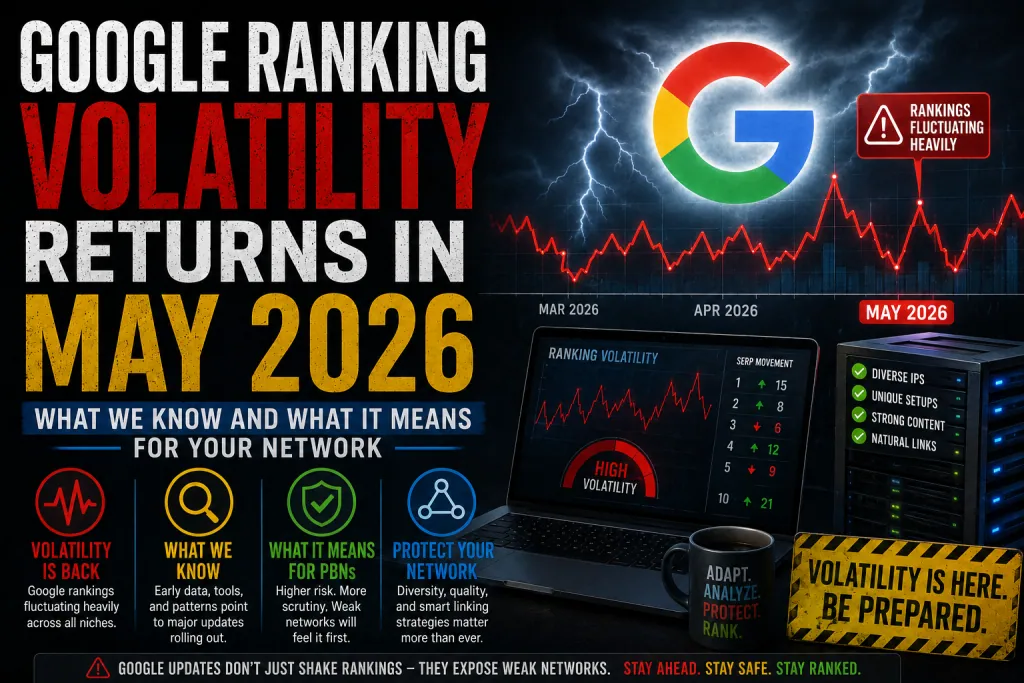
Something shifted on the morning of 8 May 2026. Multiple third-party SERP tracking tools — Semrush Sensor, Sistrix, Advanced Web Rankings, Mozcast, Algoroo, SERPstat, DataForSEO, Accuranker, Wincher, and Zutrix — began registering elevated volatility signals simultaneously. Barry Schwartz at Search Engine Roundtable flagged the pattern and noted community chatter on WebmasterWorld about ranking instability. No official announcement has come from Google. What we have is an unconfirmed volatility event arriving in the wake of one of the most turbulent stretches of algorithmic activity in recent memory. PBN.LTD runs hosting infrastructure for thousands of sites across competitive niches, and we’re tracking this directly.
The Immediate Situation: May 8 Volatility
The volatility detected on 8 May is significant enough to note but, at the time of writing, remains unconfirmed by Google’s official Search Status Dashboard. Not all tracking tools are showing identical patterns — SimilarWeb data appears inconsistent and may reflect a tool-level anomaly rather than an index-level event. But the breadth of signals across independent platforms using different keyword sets, geographic distributions, and methodologies is meaningful. When this many tools move simultaneously, it reduces the probability that any single tool is producing a false signal.
The UK market is the geography most consistently cited in community reports. WebmasterWorld threads describe UK SERPs as having been shaky for three to four days leading into May 8, with webmasters reporting spam and low-quality pages surfacing ahead of established sites in tracked keyword positions. Some are describing the experience as so degraded that users are resorting to ChatGPT to find reliable content — a comment that reflects how visibly the result quality has shifted in affected markets.
The timing matters. The March 2026 Core Update completed on 8 April — exactly one month before this volatility event. This is consistent with the pattern established across earlier 2026 volatility periods: post-update recalibration does not stop the moment Google declares a rollout complete. Secondary volatility waves following named updates have been observed repeatedly since December 2025, and the May 8 signals could reflect late-stage March recalibration, a new unconfirmed adjustment, or both running simultaneously. natural link acquisition patterns becomes harder to evaluate clearly when overlapping algorithmic cycles are in play.
Context: What 2026 Has Already Put SEOs Through
To understand why this May volatility is significant, you need the full sequence. 2026 has produced one of the most sustained periods of algorithmic turbulence in Google’s history. Three confirmed core updates have rolled out since December 2025, each accompanied by separate unconfirmed volatility events.
December 2025 Core Update
The December 2025 Core Update ran from 11 December to 29 December 2025. Its completion was followed almost immediately by the January 2026 unconfirmed volatility wave, with documented spikes on 6, 12, and 15-16 January. Traffic drops of up to 90% compared to the preceding week were reported on WebmasterWorld. The SEO community was already describing January as unusually turbulent when the next wave arrived.
February 2026 Discover Core Update
February brought a landmark event: Google’s first officially confirmed core update targeting Google Discover specifically rather than web search broadly. It began 5 February 2026 and affected how non-US publishers targeting English-language audiences were treated in the Discover feed. Separately, unconfirmed organic search volatility spiked on 2 February, 10 February, 15 February, and throughout the final week of the month. The Semrush Sensor reached 9.5 out of 10 — one of the highest readings ever recorded on that platform.
March 2026 Core Update
The March 2026 Core Update ran from 27 March to 8 April — a 12-day rollout producing some of the most dramatic individual ranking shifts of the year. Around 24% of pages holding top-10 positions dropped out of the top 100 entirely. More than 55% of monitored sites saw noticeable ranking changes within the first two weeks. Sites that have been re-evaluated across three successive core updates since December are experiencing compounding effects — each reassessment layering on top of the last. Understanding whether links are still delivering ranking value in the AI search era is increasingly relevant here, because ranking position and traffic delivery are no longer the same signal in an environment where AI Overviews absorb clicks above organic results.
What the Community Reports Are Suggesting Might Be Targeted
Google does not explain unconfirmed volatility events. What the industry works with is the pattern of winners and losers, community reports, and the directional signals from Google’s confirmed guidance. Based on reporting around the May 8 volatility and the broader 2026 pattern, several themes emerge.
Low-Value Listicles and Roundup Pages
Multiple sources report that self-promotional listicles and low-value roundup content — pages that exist primarily to capture keyword traffic without providing original analysis or genuine expertise — appear to be losing stability. This is consistent with Google’s stated direction across the E-E-A-T framework. Pages listing products or recommendations without meaningful differentiation from what’s already available in the SERP appear particularly exposed.
Scaled AI Content Operations
Scaled content operations publishing large volumes of AI-generated pages to capture wide keyword nets are being flagged and penalised faster than the same tactics would have been in 2024. Critically, how SpamBrain identifies both spam sources and the sites receiving links from them, which means sites receiving links from detected spam networks are also at risk, not just the networks themselves. The May 8 volatility may be partly a further tightening of these detections across the index.
Discovery System Removals vs Ranking Drops
A pattern reported in this volatility that’s distinct from standard ranking drops is what community members are describing as removal from discovery systems rather than simply dropping in position. Being removed from the discovery system — failing to appear in news, Discover, or content recommendation feeds at all — produces a traffic impact that looks similar on the surface but has different causes and requires different remediation.
Geographic Divergence
The UK being disproportionately affected while some markets show muted signals is consistent with what was observed during the April volatility period. Google appears to be applying variations across market segments rather than rolling changes uniformly across its entire global index. A UK-based operator seeing significant ranking movement is experiencing something genuinely different from a US-based operator whose tracking looks stable on the same dates.
The May 6 AI Overviews Changes: Confirmed and Relevant
Two days before the ranking volatility, Google made a significant set of official announcements about AI Mode and AI Overviews. On 6 May, Google announced five changes to its AI-powered search experiences. An ‘explore more’ section now appears at the end of AI responses, linking to in-depth articles and reports. Subscription-aware linking has been introduced, with AI responses highlighting whether sources come from publications a user subscribes to — early testing showed significantly higher click-through rates on these labelled links. Perspectives from Reddit, social media, and firsthand community sources are being integrated more prominently. Website previews appear on hover over AI response links. And overall, more publisher links are appearing within AI Overviews and AI Mode responses.
Google framed these changes as addressing publisher concerns about traffic loss. Referral traffic from search has dropped by 60% for small publishers and 47% for medium publishers since AI Overviews launched, according to March 2026 Chartbeat research. Some studies show click-through rates declining by up to 58% when an AI Overview is present even when the underlying organic ranking is unchanged. The May 6 changes acknowledge that this erosion is real.
Google I/O is scheduled for 20-21 May. While Google historically doesn’t use I/O to announce search algorithm changes, the active product development around AI Search features and the timing of the May 6 announcements suggest search is a central priority this cycle.
The Compounding Problem: Three Updates and No Steady State
The most important structural observation from 2026’s algorithm activity is that the old model of managing through an update and then returning to a steady state no longer describes the environment most SEO practitioners are operating in. Three successive core updates since December 2025, each accompanied by separate unconfirmed volatility events, have created a near-permanent state of recalibration. how topical authority is evaluated by Google has become a primary differentiator between sites that hold their position across multiple reassessment cycles and those that experience compounding losses.
The sites navigating this most effectively share observable characteristics: topical depth across their content rather than thin coverage of broad keyword sets; link profiles that look editorially natural rather than mechanically patterned; no dependence on a single ranking position for a disproportionate share of traffic; and technical infrastructure that isn’t introducing friction into how Google evaluates them.
What to Actually Do Right Now
The correct response to an unconfirmed volatility event is not to start making sweeping changes. Making large site-wide changes during active volatility introduces confounding variables that make it impossible to understand what caused any subsequent movement.
Diagnose Before Acting
Open Google Search Console and establish whether you’re seeing a ranking change, an impression change, or a CTR change. A ranking drop is algorithmic. An impression drop at stable rankings suggests crawl or indexation issues. A CTR drop at stable rankings and impressions suggests an AI Overview or SERP feature is absorbing clicks above your organic position. Each diagnosis requires different action.
Separate Your Traffic Sources
Segment traffic data by source. Web search, Google Discover, and referral traffic are all affected differently by different update types. The February Discover Core Update affected Discover specifically; the March Core Update affected web search. If both dropped simultaneously in May, both systems may be involved. If only one source declined, the diagnosis narrows.
Confirm Indexation Status of Affected Pages
If you’re seeing impression drops rather than ranking drops, the first step is getting new and existing PBN sites properly indexed in 2026. Pages stuck in ‘Crawled, currently not indexed’ or ‘Discovered, currently not indexed’ status receive no benefit from links pointing at them regardless of how many have been built. Confirm before assuming an algorithmic cause.
Review Your Link Profile for Volatility Exposure
If your rankings are moving more than competitor sites during this period, that differential warrants a link profile review. building a natural anchor text profile that withstands algorithmic scrutiny is one of the specific patterns that algorithmic reassessment targets — over-concentrated anchor ratios that looked acceptable during stable periods tend to be surfaced during core update recalibration when Google’s systems are re-evaluating link quality signals.
For Domain Portfolios: Check Where Quality Is Weakest
Volatile periods are when the quality differences between strong and marginal domains become visible. the framework for evaluating expired domains before building on them helps identify which properties in a network might be losing equity faster than others — domains with underlying backlink profile or history issues are devalued more aggressively during algorithmic reassessment than those with clean, coherent histories.
The Broader Trajectory
The environment rewards networks and sites built to hold value across algorithmic cycles rather than exploit the current iteration of any specific ranking signal. The factors that make PBN sites resilient — genuine topical coherence, content quality, clean technical infrastructure, link profiles that look editorially natural — are the same factors distinguishing sites surviving 2026’s volatility from those experiencing compounding losses across successive updates. The full PBN and SEO blog covers the full picture of how these factors interact across different update types, and free personalised SEO and PBN advice is available for anyone who wants to work through how their specific network is positioned against what we’re seeing right now.