
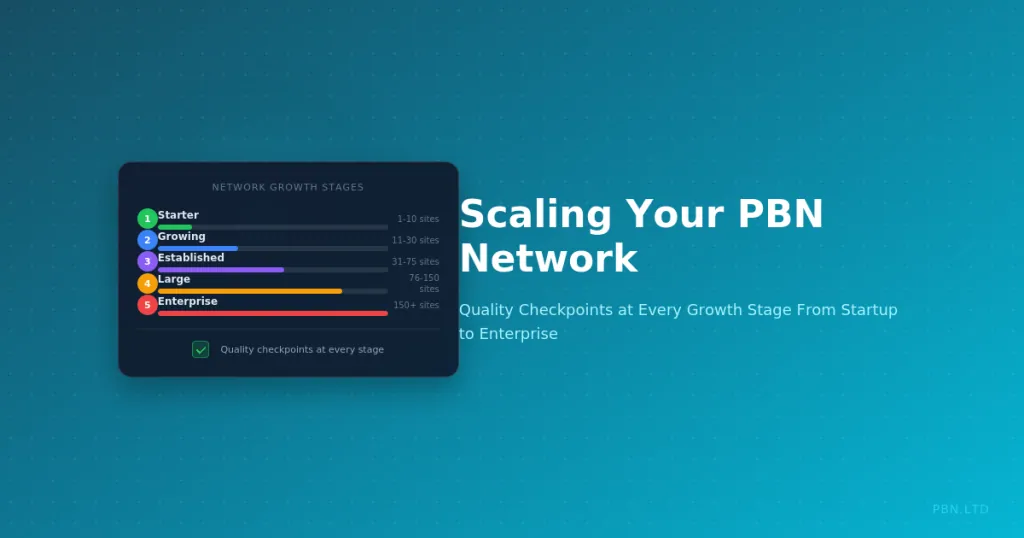
Growing a PBN network from a handful of sites to dozens or hundreds requires more than just buying more domains. Each growth stage introduces new challenges. What works for managing five sites breaks down at twenty. Processes that handle twenty sites fail at fifty.
Operators who scale successfully build systems that maintain quality as volume increases. They establish checkpoints that catch problems before they compound. They evolve their processes to match their network’s complexity.
This guide walks through the stages of PBN growth and the quality controls needed at each level. Whether you are expanding from five sites to fifteen or from fifty to two hundred, these checkpoints help ensure quality does not degrade as scale increases.
The Scaling Challenge
Understanding why scaling creates quality problems helps you prevent them.
Attention Dilution
With five sites, you can know each site intimately. You remember what content is published, when links were placed, and what maintenance each site needs. This personal knowledge enables quality control through direct attention.
At fifty sites, personal knowledge becomes impossible. You cannot remember the details of each site. Without systems to replace personal attention, quality issues go unnoticed until they cause problems.
Scaling requires replacing personal attention with systematic monitoring. The systems you build determine whether quality survives growth.
Process Breakdown
Informal processes work at small scale. You might handle domain registration manually, track hosting in a spreadsheet, and manage content through memory and notes. These approaches function when volume is low.
As volume increases, informal processes fail. Manual registration becomes error-prone. Spreadsheets get outdated. Memory cannot track hundreds of content pieces across dozens of sites.
Each growth stage requires process evolution. What worked before must be replaced with systems that handle increased complexity.
Footprint Accumulation
Small networks can avoid footprints through careful individual attention. Larger networks face footprint risk through accumulated patterns. Even small similarities repeated across many sites become detectable.
Understanding how footprint detection works becomes more critical as networks grow. The same practices that worked at small scale may create patterns visible only at larger scale.
Stage One: The Starter Network (1-10 Sites)
The initial stage establishes foundations that support later growth.
Quality Checkpoints
At this stage, quality control can be hands-on. Review each site personally before considering it complete. Check every piece of content. Verify every link placement. This direct involvement builds understanding of what quality looks like.
Domain quality is paramount. With limited sites, each domain matters significantly. Apply rigorous domain evaluation criteria to every acquisition. A weak domain at this stage dilutes your entire network’s power.
Content should exceed minimum standards. Invest in quality that makes sites genuinely defensible. This early content investment establishes the benchmark for future scaling.
Systems to Establish
Even at small scale, begin building tracking systems. Create a master document listing every site with key information: domain, registration date, hosting location, niche, content count, link placements.
Establish naming conventions and organizational structures that will scale. Decisions made now become patterns repeated across hundreds of sites later.
Document your processes. How do you evaluate domains? How do you set up new sites? How do you place links? Written procedures make processes transferable and improvable.
Common Mistakes
Skipping documentation because the network is small. This creates problems later when you cannot remember why decisions were made or how processes work.
Accepting lower quality domains because you want to reach a certain site count. Quality matters more than quantity at every stage, but especially when building foundations.
Using identical setups across all sites. Even at small scale, begin varying themes, plugins, and configurations to prevent pattern formation.
Stage Two: The Growing Network (11-30 Sites)
Growth beyond ten sites requires transitioning from personal management to systematic processes.
Quality Checkpoints
Implement regular audit schedules. Monthly reviews of all sites catch problems before they persist too long. Quarterly deep audits examine each site thoroughly.
Automated monitoring becomes necessary. Indexation checking systems alert you to deindexation without requiring manual checks of every site. Uptime monitoring catches outages before they affect link value.
Link tracking becomes essential. With dozens of link placements across many sites, manual tracking fails. Implement systems that monitor link status and alert you to removed or changed links.
Systems to Establish
Centralized management platforms replace scattered tools. Dashboard-based management provides overview visibility impossible with individual site logins.
Content calendars coordinate publication across sites. Random content timing creates natural variation, but someone must ensure content actually gets published. Calendars prevent sites from going stale.
Maintenance schedules ensure every site receives regular attention. Without schedules, some sites get forgotten while others receive excessive focus.
Common Mistakes
Continuing to manage individually when systems are needed. The approach that worked for ten sites creates chaos at twenty-five.
Neglecting sites at the edges of attention. The sites you think about least often are usually the ones with problems.
Rushing domain acquisition to hit growth targets. Pressure to grow can compromise domain quality standards.
Stage Three: The Established Network (31-75 Sites)
Mid-sized networks require operational maturity and possibly team involvement.
Quality Checkpoints
Implement tiered monitoring. Not every site needs equal attention. High-value sites with important links deserve closer monitoring than supporting sites. Allocate attention according to site importance.
Pattern detection becomes critical. At this scale, patterns can emerge without you noticing. Regular analysis of network-wide characteristics identifies similarities that need correction.
Content quality audits should sample across the network rather than reviewing everything. Statistical sampling catches quality drift without requiring review of every piece.
Systems to Establish
Standard operating procedures formalize every process. Domain acquisition, site setup, content publication, link placement, and maintenance all need documented procedures that anyone can follow.
Quality checklists ensure consistency. Before a site goes live, a checklist confirms all requirements are met. Before content publishes, quality criteria are verified. Checklists prevent shortcuts under pressure.
Exception tracking captures problems systematically. When issues arise, document them. Patterns in exceptions reveal systematic problems that need process changes.
Team Considerations
At this scale, solo operation becomes difficult. Many operators begin delegating specific tasks: content creation, technical maintenance, or monitoring. Delegation requires documented processes and quality standards.
If using team members, compartmentalize knowledge appropriately. No single team member should understand your entire network structure. Limit access to what each role requires.
Quality control checkpoints become especially important with team involvement. Trust but verify. Random audits ensure delegated work meets standards.
Stage Four: The Large Network (76-150 Sites)
Large networks require professional operations and sophisticated management systems.
Quality Checkpoints
Automated quality scoring helps prioritize attention. Systems that evaluate site health based on multiple factors identify which sites need immediate attention versus routine maintenance.
Network-wide analytics reveal trends invisible at site level. Aggregate data shows whether quality is improving or degrading across the network over time.
Segmented analysis examines different network sections separately. Sites grouped by niche, age, or purpose may show different patterns. Segment analysis catches problems affecting specific areas.
Systems to Establish
Database-driven management replaces documents and spreadsheets. Proper databases handle the data volume and enable analysis impossible with simpler tools.
Automated reporting delivers regular status updates without manual compilation. Daily, weekly, and monthly reports keep you informed of network health.
Alert escalation routes critical issues appropriately. Not every alert needs immediate attention, but some do. Systems should distinguish urgency levels and route accordingly.
Infrastructure Requirements
Hosting infrastructure must scale with the network. Proper IP diversity becomes increasingly critical and increasingly complex at this scale.
Domain registration requires diversification. Multiple registrars, varied payment methods, and distributed ownership structures prevent single points of failure.
Backup and recovery capabilities protect against catastrophic loss. At this scale, losing network data or access could take months to rebuild.
Stage Five: The Enterprise Network (150+ Sites)
Enterprise-scale networks require organizational maturity comparable to any serious business operation.
Quality Checkpoints
Dedicated quality assurance becomes a distinct function. Rather than quality being everyone’s job, specific resources focus exclusively on quality monitoring and improvement.
Continuous improvement programs identify opportunities across the network. What is learned from one site’s problems should prevent similar problems elsewhere.
External audits provide fresh perspective. Internal teams develop blind spots. Periodic outside review catches what internal processes miss.
Organizational Structure
Role specialization increases efficiency. Dedicated domain researchers, content managers, technical administrators, and quality specialists each develop deep expertise in their areas.
Governance structures determine how decisions are made. Who approves new domain purchases? Who authorizes link placements? Clear decision rights prevent both bottlenecks and uncontrolled action.
Security protocols protect network integrity. At enterprise scale, the network represents significant value. Appropriate security prevents both external threats and internal risks.
Strategic Considerations
Portfolio thinking replaces individual site focus. The network is managed as a portfolio of assets with varying risk and return profiles. Some sites are core assets. Others are experimental or expendable.
Lifecycle management plans for site retirement. Not every site operates forever. Planned retirement of degraded or outdated sites maintains network health.
Capacity planning anticipates future needs. Domain pipeline, content production capacity, and hosting resources must stay ahead of growth.
Universal Quality Principles
Certain quality principles apply regardless of network size.
Never Compromise Domain Quality
Pressure to grow can tempt operators to accept weaker domains. Resist this pressure. A network of fifty quality sites outperforms a network of one hundred weak sites. Domain quality standards should remain constant regardless of growth targets.
If quality domains are not available, slow growth rather than compromise. Better to reach scale goals late with quality than on time with weakness.
Maintain Content Standards
Content quality often degrades under scaling pressure. More sites need more content, and shortcuts become tempting. Establish minimum content standards that never flex regardless of volume demands.
If content production cannot keep pace with site growth, slow the site growth. Content quality determines site quality, which determines link value.
Diversification Over Optimization
At any scale, resist the temptation to standardize for efficiency. Variation protects against pattern detection. Even if standardized processes would be faster, maintain deliberate variation.
This applies to everything: themes and plugins, content styles, link placement patterns, registration timing, and hosting distribution. Efficiency gains from standardization are not worth the footprint risks.
Scaling Sustainably
Sustainable scaling prioritizes long-term network health over short-term growth metrics.
Growth Rate Management
Grow at a rate your systems can absorb. If quality metrics decline as you grow, you are growing too fast. Sustainable growth maintains quality throughout expansion.
Pause growth periodically to consolidate. After adding sites, take time to ensure they are properly integrated and performing before adding more. Consolidation phases strengthen the network.
System Evolution
Plan system upgrades before they become urgent. Waiting until current systems break creates crisis. Anticipate when current tools and processes will become inadequate and plan transitions in advance.
Invest in systems ahead of need. Better to have capacity than to scramble when growth hits limits. This applies to tools, processes, and team resources.
Quality-First Culture
Build quality expectations into everything. Every process, every checkpoint, every decision should ask whether quality is maintained. Growth that compromises quality is not success.
Celebrate quality achievements alongside growth metrics. Recognition for quality performance reinforces its importance throughout operations.
Conclusion
Scaling a PBN network successfully requires evolving your approach at each growth stage. Systems that work at one scale must be replaced with more sophisticated approaches as the network grows.
Implement quality checkpoints appropriate to your current scale. Monitor for problems systematically. Build systems that maintain quality as volume increases.
Never compromise on fundamentals. Domain quality, content standards, and footprint diversification matter at every scale. Growth achieved through shortcuts creates fragile networks that eventually fail.
For PBN hosting infrastructure that scales with your network, our platform supports operations from startup to enterprise scale. Build with confidence knowing your hosting foundation handles growth without compromising the diversity and performance your network requires.