
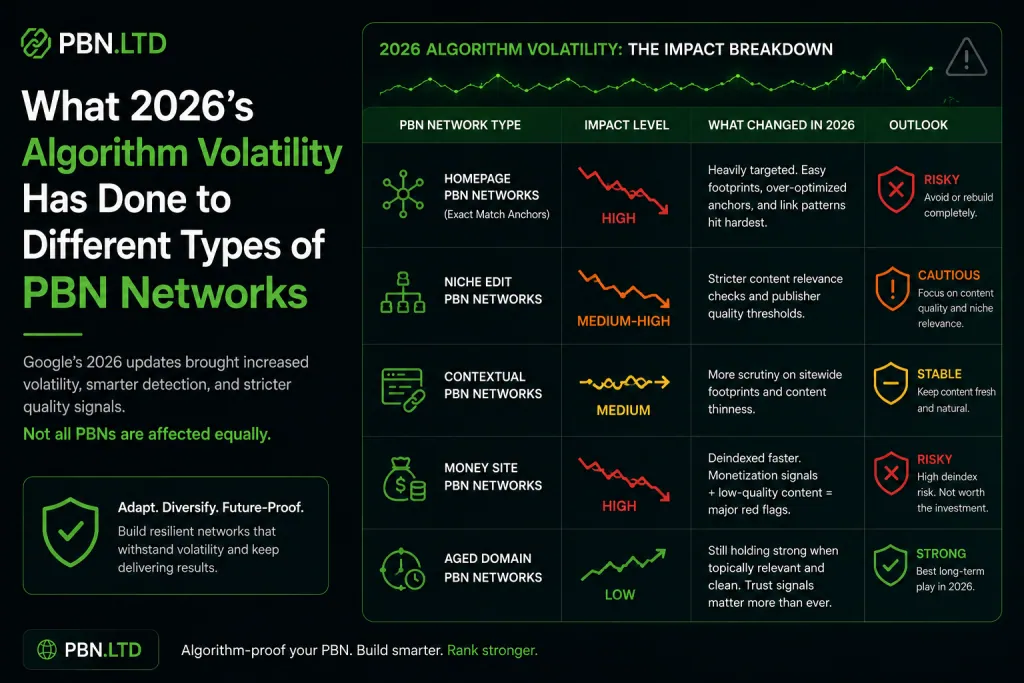
Not all networks experienced 2026’s algorithm volatility the same way. Some came through the March core update and accompanying spam enforcement with rankings intact — and in some cases improved. Others lost the majority of the link value they’d spent years accumulating, seemingly overnight. From the outside, these might look like equivalent operations: a collection of domains, some content, links pointing at money sites. From the inside — and from the perspective of what Google’s systems are now capable of evaluating — they were nothing alike.
Understanding why certain network types weathered 2026’s updates while others did not requires going beyond surface-level explanations. It requires looking at what Google’s spam classifiers specifically targeted in March, what the core update’s content reassessment rewarded, and how the compounding effect of three successive updates since December 2025 has redistributed authority across different network architectures. how Google’s algorithm has evolved over a decade to target network patterns provides the historical context for how we arrived at today’s detection capabilities — and how dramatically the landscape has shifted from even five years ago.
The 2026 Update Sequence and Why It Was Different
The March 2026 volatility was not a single event. It was the convergence of two distinct enforcement mechanisms launched in close succession, each targeting different failure modes, and their combined effect was harder to diagnose and more difficult to recover from than either would have been alone.
The March spam update launched in two waves. The first wave, in early March, targeted AI-generated doorway pages and cloaked content. The second wave, which began on March 18, extended enforcement specifically to link schemes — expired domain redirects used as network components, private blog networks that had been refreshed with AI-generated content, and sponsored link structures using indirect attribution to obscure paid relationships. The March core update then began rolling out on March 27, immediately after the spam update completed, and ran through April 8.
This sequencing created a compounding problem. Sites and networks that had been flagged or discounted by the spam update were then reassessed by the core update under already-weakened conditions. The overall ranking volatility peaked at a Semrush Sensor score of 9.5 — one of the highest readings ever recorded on that platform — with approximately 24% of pages holding top-10 positions dropping out of the top 100 entirely during the rollout window. The operators who understand precisely why specific network types fared the way they did are better positioned for whatever comes next.
Network Type One: AI-Refreshed Content at Scale — Hardest Hit
The network type that experienced the most severe and consistent losses across 2026’s volatility was what the spam update’s enforcement data specifically named: private blog networks refreshed with AI-generated content. These were typically established networks — domains with genuine history, real backlink profiles from their original incarnations — that had been maintained at volume by pumping AI-generated articles across dozens or hundreds of sites on an automated publishing schedule.
The pattern was attractive from an operational standpoint. AI content dramatically reduced the per-article cost of keeping network sites looking active. Sites that had been publishing two or three genuine articles per month could now publish twenty. The apparent activity level increased. The actual content quality — in terms of specificity, depth, real-world insight, and topical coherence — collapsed.
Google’s March spam update identified this pattern with what multiple SEO monitoring firms described as surgical precision. how SpamBrain targeted network patterns across the March 2026 campaign. Sites using programmatic content generation at scale that also had AI-refreshed PBN link networks saw compounded losses from both the spam update and the core update, with some operations reporting over 80% of their peak March organic traffic gone by the time the core update completed on April 8.
The specific mechanism wasn’t simply ‘AI content is bad.’ It was that AI-generated content at scale, applied across a network of sites, produces a detectable fingerprint: homogeneous sentence structures, a characteristic distribution of phrase patterns, topical coverage that’s broad rather than deep, and a conspicuous absence of the original insights, first-person experience signals, and specific detail that genuine editorial content tends to contain. Applied across 50 or 100 sites simultaneously, this fingerprint becomes recognisable at a network level, not just a site level.
Network Type Two: Expired Domain Redirects — Significantly Devalued
The second network type specifically named in the March spam update’s second wave was expired domain redirects — the strategy of acquiring domains with established backlink profiles and pointing them directly at money sites via 301 redirects rather than rebuilding content on them.
This approach had a clear logic: the redirect passes the acquired domain’s link equity to the money site without the overhead of content production. The problem is that how Google evaluates rebuilt domains versus genuine sites — and a 301 redirect to an unrelated destination is one of the clearest signals available that the acquisition was made specifically to transfer link equity rather than to continue a legitimate web presence. The March 2026 enforcement specifically targeted this pattern, devaluing redirect chains that fit the profile of opportunistic equity transfer rather than genuine site migration.
The impact wasn’t uniform. Redirects from domains that had been acquired with long lead times before the money site’s link campaign began, that pointed to genuinely topically relevant destinations, and that sat within a broader link profile rather than constituting the primary link source, held up better than same-day acquisition and redirect setups with obvious commercial intent. But the overall direction of the update was clearly toward discounting this approach.
For operators who have relied heavily on redirect strategies, the core question post-update is whether to rehabilitate the redirected domains — actually rebuilding content on them and converting them to genuine network sites — or to accept the devaluation and replace them with better-structured assets. selecting expired domains that hold their value through algorithm cycles provides the evaluation framework for assessing which domains are worth that rehabilitation investment.
Network Type Three: Templated Build Networks — Progressively Losing Ground
Templated networks — those built using identical or near-identical WordPress themes, the same plugin stacks, the same page structures for About, Contact, and Privacy pages, and content produced to a minimum viable standard — didn’t experience the catastrophic single-event losses that AI-refreshed and redirect networks did. Their losses have been more gradual, cumulative across multiple update cycles, and in some ways more insidious because of it.
The October 2023 update began the systematic reduction in value passing through low-quality network sites. The December 2025 core update accelerated it. The March 2026 core update completed a reassessment that has left thin, templated network sites passing significantly less equity than their domain metrics might suggest. Google’s quality evaluation now operates at a site level — a network site that looks like it was built to hold links rather than to serve an audience is weighted accordingly, regardless of how strong the domain’s pre-acquisition backlink profile was.
The footprint dimension is also relevant. Networks where sites share obvious technical signatures — matching themes, consistent plugin lists visible in page source, similar site structures — are more vulnerable to network-level identification than individually built sites. The question of building genuine topical authority across individual PBN sites across individual network sites has become central to how much equity each site passes, because a site Google identifies as a genuine niche resource is evaluated differently from one it assesses as a content wrapper around outbound links.
Network Type Four: Topically Coherent, Editorially Built Sites — Most Resilient
The network type that demonstrated the most consistent resilience through 2026’s update sequence shares a clear set of characteristics, and those characteristics are not accidental. They reflect a deliberate build philosophy that prioritises the site’s credibility as a genuine web property over the efficiency of its link deployment.
Sites built with original, in-depth content specific to their niche — material that demonstrates real subject knowledge rather than surface-level coverage — maintained their indexation and link equity through all three major update cycles. PBN sites built to function as genuine niche web properties isn’t just a framing concept; it’s the operational reality of what separates networks that compound in value over time from those that degrade.
The pattern among resilient network sites, based on monitoring data across the March update window, shows several consistent characteristics. Content averaging above 1,000 words with genuine topical depth and specificity. Site structures that include genuine category pages, internal linking that reflects editorial coherence rather than mechanical optimisation, and About pages with credible author or editorial signals. Outbound link patterns that include linking to authoritative external sources, not just the operator’s money sites. And crucially — in more than a few cases — actual organic rankings for the site’s own keyword targets, reflecting that Google has independently assessed the site as worth ranking.
This last factor — network sites that have earned their own organic visibility — held up best of all. A site that Google has assessed as a legitimate, useful resource for a particular topic, demonstrated by ranking it for relevant queries, is evaluated very differently from one that exists only to hold outbound links. The algorithmic trust extended to a site with its own organic footprint creates a different relationship with Google’s systems than the trust — or lack thereof — extended to a site with zero organic presence and a high ratio of outbound links to original content.
Network Type Five: Niche-Concentrated Local Networks — Largely Unaffected
A fifth network type deserves separate consideration: tightly niche-concentrated networks built specifically to support local service businesses in geographically specific markets. These networks — smaller by necessity, more focused by design, and often built on domains with genuine local provenance — were among the least affected by both the March spam update and the core update.
The spam update’s enforcement data from third-party analysis confirmed that local service businesses with geographically concentrated link portfolios were among the verticals least affected. This reflects a genuine difference in how Google’s systems evaluate local link relevance. A network built around a regional niche — local news, area services, geographically specific professional content — with links pointing at a money site operating in the same geography presents a topically and geographically coherent picture that looks nothing like the patterns the spam update was targeting.
The implication for operators working in local search is that network architecture that mirrors the actual geography and industry context of the money site’s market is inherently more durable than general-purpose networks deployed without that coherence. Smaller networks with higher relevance concentration consistently outperformed larger networks with broader topical footprints through 2026’s volatility.
What the Patterns Reveal About Where Detection Is Heading
Reading across these network type outcomes produces a picture of what Google’s systems are progressively getting better at evaluating — and therefore what operators building networks for the medium and long term need to account for.
Detection is operating at the network level, not just the site level. Individual sites that might pass evaluation in isolation are being assessed in the context of their network relationships — shared hosting patterns, coordinated link timing, consistent outbound link targets. The February 2026 Discover Core Update demonstrated that Google is now running separate evaluation models across different content distribution surfaces simultaneously. The March 2026 double update demonstrated that spam enforcement and content quality reassessment can be deployed in sequence, compounding each other’s effects.
The direction of travel is unambiguous: networks that function as genuine web properties — where individual sites have real content, real topical focus, and the structural signals of genuine independent operation — are becoming more durable relative to networks optimised purely for link deployment efficiency. The investment required to build to that standard is higher. The alternative is building to a lower standard and accepting either progressive devaluation or sudden enforcement exposure. For operators choosing the former, PBN content standards that hold up through algorithmic reassessment covers the content investment that distinguishes durable sites from disposable ones, and link velocity patterns that avoid triggering footprint signals addresses how link deployment timing interacts with network-level footprint signals during volatile algorithm periods.
Practical Conclusions for Network Operators
Several actionable conclusions emerge from the 2026 volatility data for operators auditing or restructuring their networks.
- Audit AI content across network sites immediately. If network sites were refreshed with AI-generated articles over the past 12-18 months, assess whether those sites are still indexing properly and passing equity. AI content at scale is now a specific targeting signal, not just a quality concern.
- Review redirect-dependent components. Domains set up as pure equity redirects rather than genuine rebuilt sites are at elevated risk of being further discounted. The choice between rebuilding them properly or retiring them and replacing them with better assets needs to be made on the merits of each domain’s underlying profile.
- Prioritise topical coherence in new builds. Domains being added to a network in 2026 should be matched to niches with genuine precision, built with original content that demonstrates real topical knowledge, and not deployed as link sources until they have established their own indexation pattern.
- Monitor network-level footprint signals. Shared technical signatures across network sites — identical themes, consistent plugin stacks, similar structural patterns — increase network-level detection risk. Technical diversity in site builds is a meaningful part of network longevity in the current environment.
Operators managing private blog network hosting across multiple sites and link targets are navigating the most complex algorithmic environment in Google’s history. The differentiation between network types that 2026’s updates have made visible is likely to persist and sharpen through future update cycles. If you want to work through what these patterns mean for your specific network configuration, free personalised PBN and SEO advice is available.