
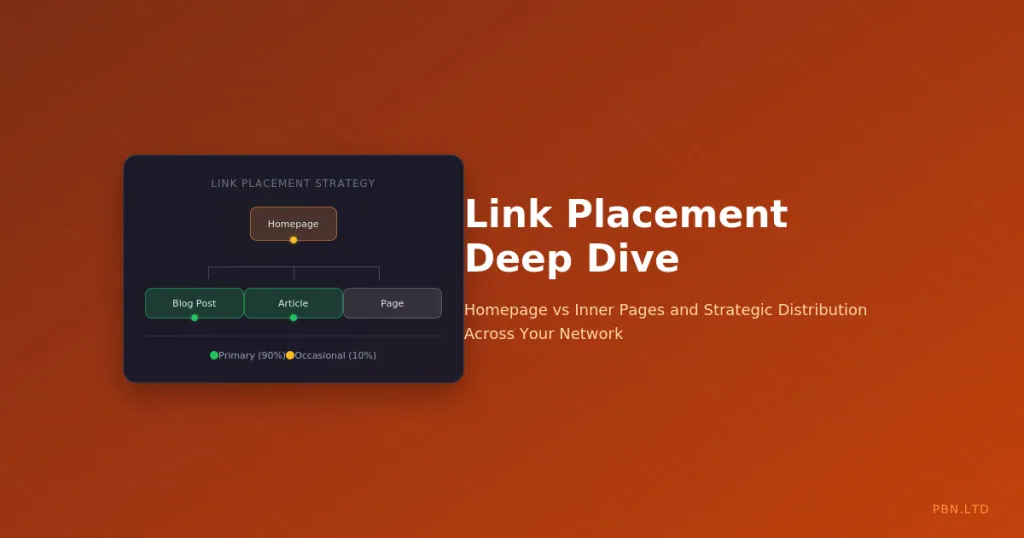
Where you place links on PBN sites affects their value, their detectability, and their long-term sustainability. A link from the homepage carries different weight than a link buried in a three-year-old blog post. A link in the main content differs from a link in the sidebar.
Understanding link placement strategy helps you extract maximum value from your PBN sites while maintaining natural-looking link profiles. Poor placement decisions waste site authority and create patterns that make networks easier to detect.
This guide examines link placement from multiple angles. We cover where links should appear on individual pages, how to distribute links across site structures, and how placement decisions affect both SEO value and footprint risk.
Homepage Links vs Inner Page Links
The distinction between homepage and inner page links matters for both link value and link profile naturalness.
Homepage Link Characteristics
The homepage typically concentrates the most authority on any website. External backlinks most often point to homepages. Internal links from every page flow back to the homepage. This authority concentration means homepage links often carry more raw power than inner page links.
However, homepage links also face greater scrutiny. A link from a homepage is more visible and more likely to be noticed during manual review. Homepage links appear on every visit to the site, making them persistent and prominent.
Natural websites rarely link out from their homepages to unrelated sites. A gardening blog’s homepage linking to a payday loan site is immediately suspicious. Even links to related sites from homepages are relatively uncommon in natural link profiles.
Inner Page Link Characteristics
Inner pages, particularly blog posts and articles, accumulate links naturally. Content pages get referenced, cited, and linked to as sources. Links from within content appear natural because that is how real content creators cite sources and reference related resources.
Individual inner pages typically carry less authority than the homepage, but a well-structured site distributes authority throughout. Pages with strong internal linking and their own external backlinks can carry substantial value.
Inner page links also provide contextual relevance. A link within an article about kitchen renovations carries topical context that a homepage link cannot provide. This contextual relevance may contribute to how search engines evaluate the link.
When to Use Each Type
For most PBN operations, inner page links should dominate. They appear more natural, provide contextual relevance, and allow for diverse anchor text within content. Homepage links should be rare and reserved for situations where they make contextual sense.
A ratio of roughly 90 percent inner page links to 10 percent or fewer homepage links reflects natural link profiles. Some money sites might receive only inner page links from your network, reserving homepage links for particularly high-authority PBN sites where the value justifies the visibility.
On-Page Link Placement
Within a single page, link placement affects both perceived value and naturalness.
In-Content Links
Links embedded within the main body content carry the most value and appear most natural. When a link flows naturally within a sentence as part of the content’s narrative, it resembles how real authors cite sources and recommend resources.
The surrounding content provides context. A link to a money site about mortgage rates appearing within a paragraph discussing home financing makes topical sense. Search engines can evaluate this context when assessing the link’s relevance and value.
In-content links also allow natural anchor text usage. The anchor text can be varied, contextual, and integrated into sentences naturally. This supports healthy anchor text profiles that avoid over-optimization patterns.
Position Within Content
Where within the content a link appears matters. Links in the first few paragraphs may carry more weight than links buried near the end. Users are more likely to see and click early links. Search engines may interpret this placement as indicating importance.
However, natural content places links where they fit contextually rather than forcing them into specific positions. A link belongs where the topic naturally calls for a reference, not necessarily in the first paragraph.
Vary link positions across your network. Some links in opening paragraphs where context supports it. Some in middle sections. Some near the end as additional resources. This variation looks natural and avoids positional patterns.
Sidebar and Footer Links
Links in sidebars and footers typically carry less value than in-content links. These areas often contain navigation, advertisements, and supplementary information. Search engines have learned to weight these areas differently from main content.
Sidebar links also appear on every page of a site. A blogroll in the sidebar creates site-wide links from every page to the linked sites. This amplifies both the potential value and the potential risk of these links.
For PBN purposes, avoid placing money site links in sidebars or footers. These placements look more like paid or manipulative links than editorial endorsements. Keep money site links within main content where they appear natural.
Author Bio Links
Author bio sections commonly contain links. Real authors often link to their own websites, social profiles, or portfolios. This creates a natural placement for certain types of links.
Author bio links work best when the linked site could plausibly be the author’s project or business. A fictional author who writes about personal finance might naturally link to a mortgage comparison site they supposedly operate. This requires consistent author personas across content.
Do not overuse author bio links. Not every post needs an author bio with links. Mix posts with bios and posts without. Vary which posts include linked bios to avoid obvious patterns.
Distribution Across Site Structure
How you distribute links across a PBN site’s structure affects both effectiveness and sustainability.
Concentrating vs Spreading Links
You can place multiple links to your money site across different pages of a PBN site, or concentrate all linking power in a single well-optimized page. Each approach has trade-offs.
Concentrated linking puts all outbound link equity through one page. If that page ranks, receives traffic, or gains its own backlinks, the value compounds. But concentration also creates a single point of failure. If that page is deindexed or the link is removed, all value is lost.
Distributed linking spreads risk across multiple pages. No single page failure eliminates all value from the PBN site. However, diluting links across many pages means each individual link may carry less weight.
For most situations, moderate distribution works best. Two to three links to a money site across different pages of a PBN site balances value concentration with risk distribution.
New Posts vs Existing Content
Links can be placed in newly created posts or inserted into existing content that has had time to age and potentially accumulate its own authority.
New posts allow you to create content specifically designed around the link and its context. The content can be crafted to support the linked topic perfectly. However, new posts have no history, no existing authority, and need time to be crawled and evaluated.
Existing content may already be indexed, may have accumulated some authority, and may even rank for relevant queries. Adding links to established content can provide immediate value. However, the content was not written with the link in mind, so integration requires care.
A mix of both approaches serves most networks well. Some links in purpose-built new content. Some links added to relevant existing content where they fit naturally.
Category and Tag Page Considerations
Category and tag pages aggregate content but are not ideal for money site links. These pages often duplicate content available elsewhere on the site and may receive lower crawl priority.
Links on category pages also become site-wide in effect as new posts are added to categories. A link in a category description appears on every post listing page for that category, creating unintended link multiplication.
Reserve category and tag pages for internal navigation. Place money site links on individual posts and pages where context is specific and link appearance is controlled.
Link Density Considerations
How many links appear on a page affects how search engines evaluate those links and how natural the page appears.
Outbound Link Ratios
Pages with many outbound links dilute the value passed through each link. A page with one hundred outbound links passes less equity through each link than a page with five outbound links.
For PBN pages carrying money site links, keep outbound link counts reasonable. Three to seven outbound links in a typical blog post looks natural. More than that starts to look like a link directory or resource dump.
Our guide on PBN outbound link strategy covers how to balance money site links with links to authority sources that make pages appear more natural.
Internal vs External Link Balance
Natural websites link more internally than externally. Blog posts link to other posts on the same site, to category pages, and to pillar content. External links appear but do not dominate.
PBN posts should include internal links alongside external links. This internal linking also distributes authority throughout the PBN site, potentially strengthening overall site architecture and improving the value of all pages including those with money site links.
A typical post might include three to five internal links and two to four external links including the money site link. This balance looks natural and provides site structure benefits.
Link Clustering Avoidance
Avoid clustering all links in one section of a post. Links bunched together in a single paragraph look like a resource list rather than natural citations. Spread links throughout the content where they fit contextually.
Similarly, avoid placing the money site link immediately adjacent to other outbound links. Surrounding a money site link with links to authority sites in the same sentence or paragraph can look like an attempt to hide the money site link among legitimate references.
Space links throughout content naturally. Let each link have its own context and purpose within the content’s flow.
Strategic Distribution Across Networks
Link placement strategy extends beyond individual sites to network-level distribution.
Varying Placement Patterns
If every PBN site places money site links in exactly the same way, that consistency becomes a footprint. Vary placement approaches across your network.
Some sites use author bio links. Others never use author bios. Some place links early in content. Others integrate links mid-article. Some sites have one post with money site links. Others have links spread across multiple posts. This variation prevents placement patterns from revealing network connections.
Matching Placement to Site Character
Different PBN sites should have different characters and link placement should match those characters.
A resource-oriented site naturally includes more outbound links, potentially in resource list formats. A personal blog-style site naturally includes fewer outbound links, integrated into narrative content. A news-style site naturally cites sources frequently throughout articles.
Define the character of each PBN site and ensure link placement matches that character. A personal blog that suddenly has resource lists with ten outbound links looks inconsistent with its established character.
Distribution Across Money Site Pages
Natural link profiles point to various pages on a website, not just the homepage. Your PBN links should target different pages on your money sites.
Some links to the money site homepage. Some to key service or product pages. Some to valuable blog posts or resources. This distribution looks natural and helps different pages on your money site rank for their target keywords.
Plan link distribution across your money site’s pages before executing. Know which pages need the most link support and allocate PBN links accordingly while maintaining distribution variety.
Managing Links Over Time
Link placement is not a one-time decision. Links need management as content ages and networks evolve.
Link Monitoring
Track where links are placed and verify they remain in place. Links can disappear through site hacks, accidental edits, or theme changes. Our link tracking tools help monitor link placement across your network.
Periodic verification catches problems before they persist too long. A monthly check of key link placements ensures your network continues delivering value.
Updating Link Contexts
Content surrounding links may become outdated. Statistics become stale. References to current events become historical. Outdated content reflects poorly on the site and may reduce the value of links within that content.
Periodically refresh content containing important links. Update statistics, refresh examples, and ensure the content remains relevant. Fresh content maintains site quality signals and supports the links within it.
Removing or Relocating Links
Sometimes links need to be removed or moved. A page might be performing poorly. A money site’s target pages might change. A link’s anchor text might need adjustment.
Make changes gradually rather than all at once. Sudden removal of many links or sudden changes across many placements can trigger algorithmic attention. Spread changes over time to appear more natural.
Document link changes. Knowing when links were added, modified, or removed helps correlate ranking changes with link changes. This data informs future placement decisions.
Common Placement Mistakes
Understanding common mistakes helps you avoid them.
Identical Placement Patterns
Using the same placement approach across all sites creates an obvious footprint. If every PBN site has a money site link in the third paragraph with identical surrounding sentence structures, that pattern is detectable.
Vary placement deliberately. Create variety not just in position but in context, surrounding content, and integration style.
Over-Linking Individual Pages
Placing too many money site links on a single page dilutes value and looks unnatural. A blog post with five links to the same money site is obviously promotional regardless of how well the links are integrated.
Limit money site links to one or two per page maximum. If you need more link volume from a PBN site, create more pages rather than overloading individual pages.
Ignoring Page Quality
Placing links on thin, low-quality pages wastes placement effort. Links on pages Google considers low quality pass less value and may even create negative associations. Ensure pages carrying money site links meet content quality standards.
Better to have fewer links from high-quality pages than many links from thin content. Quality of the linking page matters as much as link placement within the page.
Conclusion
Strategic link placement maximizes the value you extract from PBN sites while maintaining natural appearance. Inner page links dominate healthy placement strategies. In-content integration provides contextual relevance. Distribution across site structures balances value with risk.
Vary placement approaches across your network. Match placement to individual site characters. Monitor links over time and update contexts as content ages.
Avoid common mistakes like pattern creation, over-linking, and ignoring page quality. Each placement decision should consider both immediate effectiveness and long-term sustainability.
Link placement works alongside other PBN optimization practices to create networks that deliver sustained ranking benefits. For PBN hosting and network management that supports sophisticated link placement strategies, our platform provides the infrastructure and tools serious operators need.